- A good chemical free floor cleaner should do more than smell pleasant. It needs to handle dust, turmeric spills, and hard-water marks on Indian floors without leaving fumes, sticky residue, or the strong carbolic smell that follows conventional phenyl cleaners for hours.
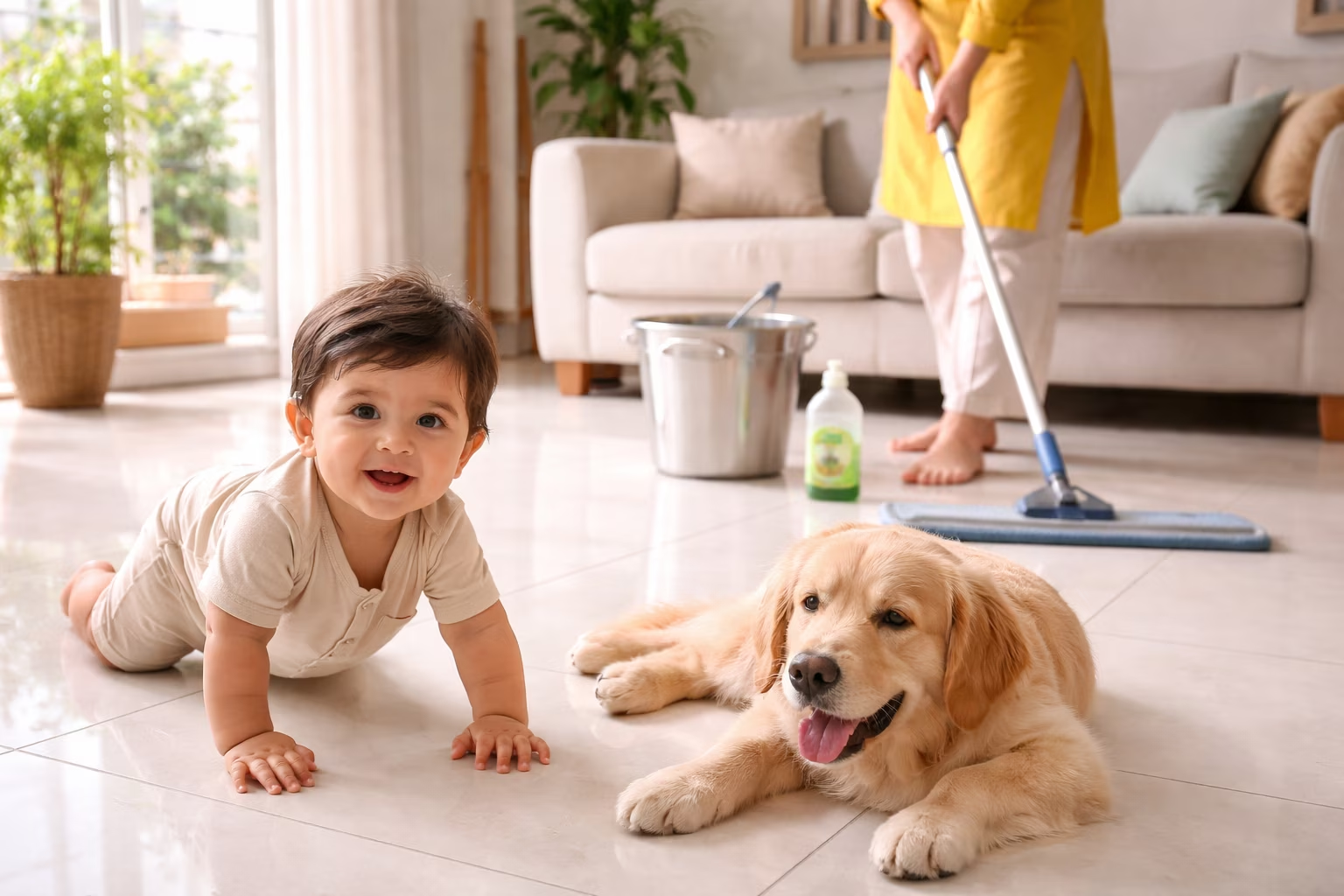
- The floor is where VOCs from phenyl settle and where babies crawl and pets lie down. A 2022 study found floor-level VOC concentrations 2 to 3 times higher than at adult breathing height.
- Bio-enzyme cleaners are the most practical natural floor cleaner for Indian homes: they handle organic grime and turmeric stains well, leave no residue, and some continue breaking down organic matter on the surface after mopping.
- Price per mop matters more than bottle price. A Rs 350 concentrate diluting 1:40 costs significantly less per clean than a Rs 199 ready-to-use cleaner used undiluted.
A chemical free floor cleaner needs to do more than smell pleasant. In Indian homes, it has to handle dust, turmeric spills, hard-water marks, and daily foot traffic without leaving behind the strong phenyl smell that many parents and pet owners want to avoid. That matters most in homes where babies crawl directly on the floor and pets lick their paws after mopping.
The carbolic smell from traditional Indian floor cleaners comes from cresols and terpenes, coal tar derivatives classified as toxic to the liver and nervous system in animal studies. Most Indian consumers associate this smell with properly cleaned floors. It is not. It is the smell of VOCs evaporating slowly from your floor surface at exactly the height where infants breathe and pets rest. The best natural floor cleaner cleans equally well without that tradeoff.
In This Article
- What chemical-free actually means on a floor cleaner label
- The phenyl problem: why the smell is not a sign of clean
- The 7 best chemical free floor cleaners in India
- Which natural floor cleaner works on your floor type
- Dilution math: cost per mop compared
- How to choose a chemical free floor cleaner for babies and pets
- Quick comparison table
- FAQs
What Chemical-Free Actually Means on a Floor Cleaner Label
The phrase chemical free floor cleaner is used loosely by almost every eco brand in India. Every cleaner contains chemicals; the real question is whether it avoids the harsh ones: phenyl (cresols), bleach, ammonia, and synthetic fragrances from petrochemical bases. For this guide, chemical-free means non-toxic, low-VOC, surfactant-based or bio-enzyme based, and suitable for regular use around babies and pets without thorough rinsing after every mop.
What to look for: plant-derived or bio-based surfactants, a clear dilution ratio, no cresols, no bleach, no ammonia, and full ingredient disclosure. What to avoid: any product that smells strongly of carbolic, lists sodium hypochlorite as an active, or uses “fragrance” as a catch-all ingredient without specifying the source.
Tip
If the product label does not list ingredients clearly or just says “contains surfactants and fragrance,” treat it the same way you would any conventional cleaner. Genuine chemical free floor cleaners in India now include full ingredient lists as a transparency standard. Born Good, Koparo, and Satopradhan all publish complete ingredient breakdowns.
The Phenyl Problem: Why the Smell Is Not a Sign of Clean
The carbolic smell from Domex, Lizol, and local floor phenyl comes from cresols, a family of organic compounds derived from coal tar. Cresols are effective disinfectants but are also classified as acutely toxic to the liver and kidneys at high doses and as respiratory and skin irritants at concentrations found in standard floor cleaners. They are VOCs that evaporate at room temperature and settle at floor level as the floor dries.
A 2022 study published in Environmental Health Perspectives found VOC concentrations 2 to 3 times higher at 30cm from the floor than at adult breathing height. A crawling infant breathes at approximately 20 to 30cm from the floor. A cat or dog lying down breathes at 10 to 20cm. The floor is a slow-release VOC source at exactly the heights that matter most for babies and pets.
Quick Fact
India’s Bureau of Indian Standards classifies floor cleaning products under IS 6313 but does not require full ingredient disclosure on consumer packaging. A product labelled “eco” or “herbal” can legally contain cresols, chlorine, or synthetic fragrance without listing them. Independently certified products (USDA bio-based, PETA-certified, Green-Pro) carry more reliable claims.
The 7 Best Chemical Free Floor Cleaners in India
Each product below was assessed on four criteria: ingredient transparency, effectiveness on Indian floor types and stains, baby and pet safety positioning, and value at standard dilution. Prices reflect brand website and major retail platform figures from early 2026.
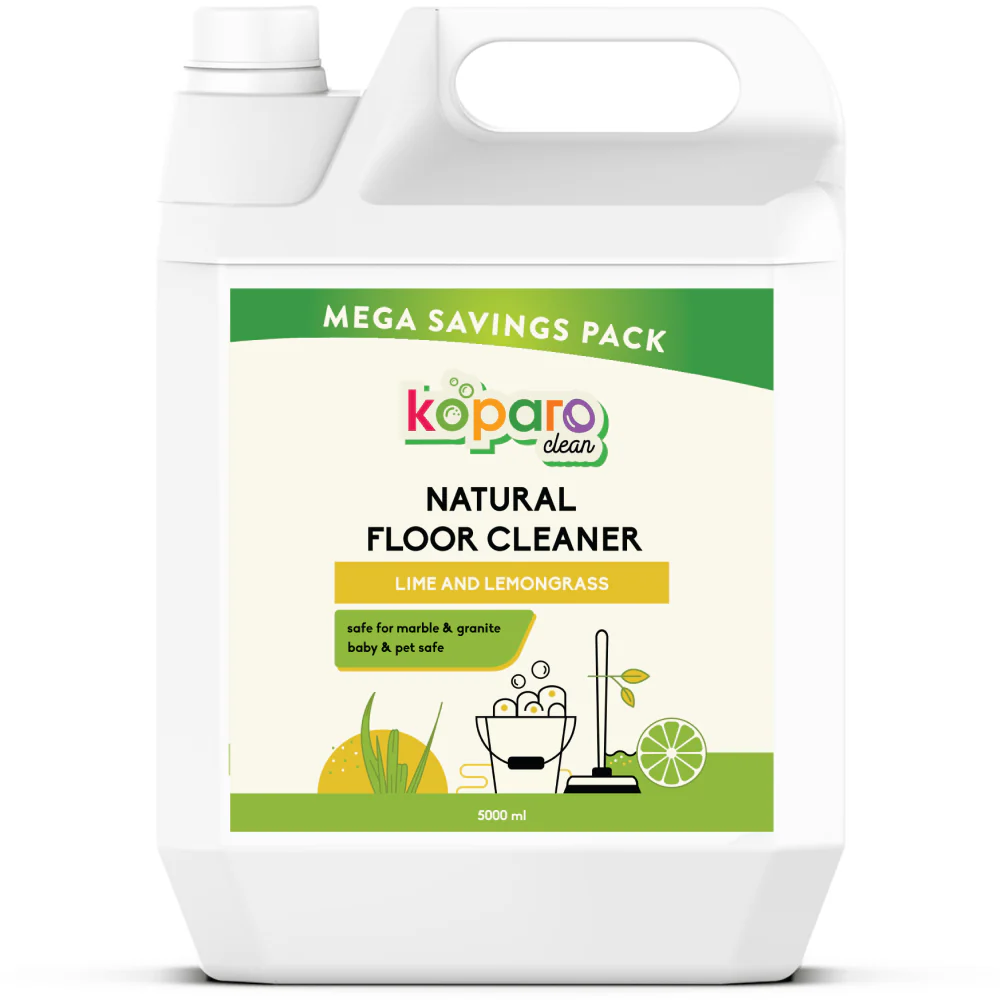
1. Koparo Clean Natural Floor Cleaner (Best Overall Daily Cleaner)
- Price: Rs 199 / 1L
- Key Ingredients: Plant-derived surfactants, essential oils
- Free Of: Phenyl, bleach, ammonia, phosphates
- Best Floor: Vitrified tile, sealed surfaces
- Baby & Pet Score: 9 / 10
Koparo is the easiest daily switch for most Indian homes. Its plant-derived surfactants clean routine dust and foot traffic effectively, and it dries without sticky residue, which matters on vitrified tile. It is marketed as paw-safe by the brand, and the formula avoids the heavy carbolic smell that follows conventional phenyls around a home for hours.
Note: Koparo uses essential oils including eucalyptus and lemongrass variants. These are widely tolerated but can irritate cats in poorly ventilated spaces. If you have cats, use the unscented variant or choose a bio-enzyme cleaner instead.
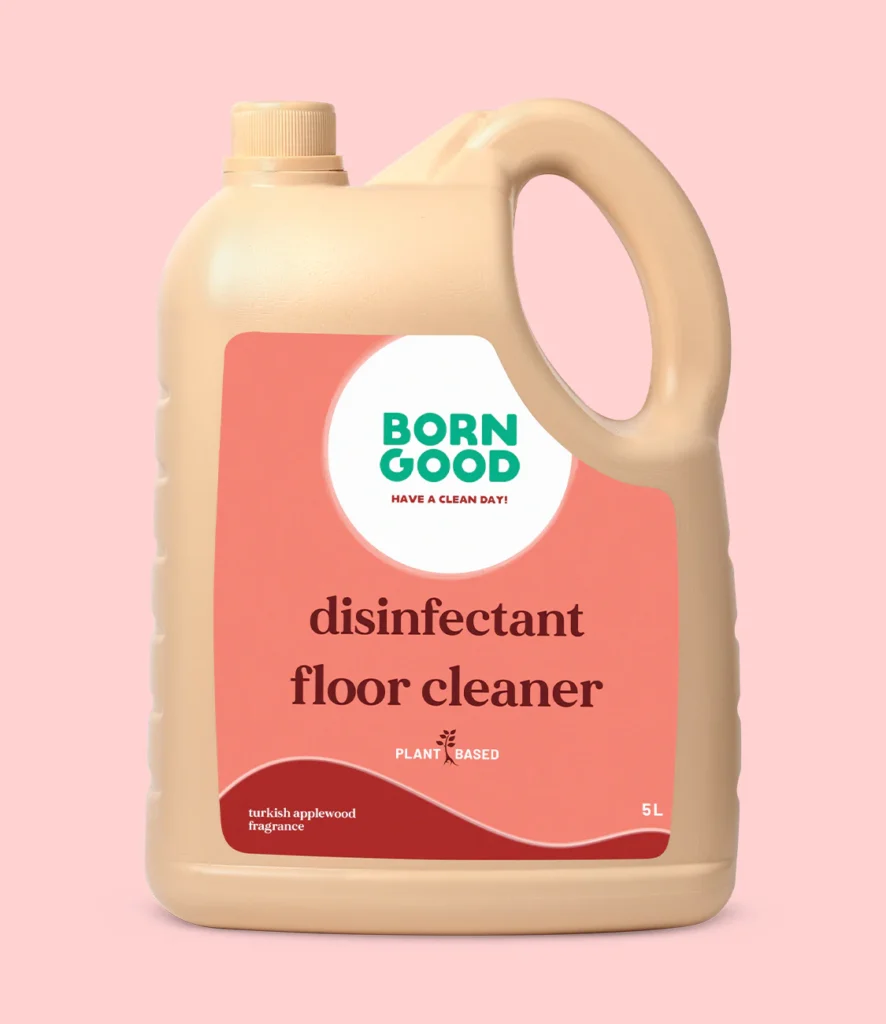
2. Born Good Plant-Based Disinfectant Floor Cleaner (Best For Disinfecting)
- Price: Rs 199 to Rs 249 / 1L
- Key Ingredients: Plant-based disinfectant system, bio-based surfactants
- Free Of: Phenyl, bleach, chlorine, SLS
- Best Floor: Vitrified tile, kitchen floors
- Baby & Pet Score: 9.5 / 10
Born Good is the only product in this list with a USDA bio-based certification and a verified 99.9% germ-kill claim from plant-based ingredients rather than bleach or chlorine. It is the strongest choice for homes where hygiene beyond routine mopping matters: kitchen-adjacent floors, areas near litter trays, and high-touch zones. It is also refill-friendly, which reduces plastic use over time.
Note: Patch-test on marble or natural stone before full use. Some users report mild residue on very smooth granite at full dilution. Reduce concentration if residue appears.
3. Satopradhan Bio-Enzyme Floor Cleaner (Best Bio-Enzyme Pick)
- Price: Rs 250 / 1L
- Key Ingredients: Fermented bio-enzyme blend, citrus, lemongrass, neem
- Free Of: All synthetic chemicals, SLS, bleach, phenyl
- Best Floor: All Indian floor types
- Baby & Pet Score: 9 / 10
Satopradhan’s bio-enzyme formula is the closest a ready-to-use product gets to a homemade citrus bio-enzyme cleaner. Fermented microbes continue breaking down organic matter on the floor surface after mopping, making it particularly effective on turmeric spills, food residue, and bathroom-adjacent floors. The scent is mild and plant-derived rather than perfumed. The 1.9L can works out to Rs 185 per litre, making it the most economical refill option in this list.
Note: Bio-enzyme cleaners need slightly more dwell time on stubborn marks than conventional detergents. On heavily soiled areas, mop twice or leave the solution for 2 to 3 minutes before wiping.
4. EcoRoot Bio-Enzyme Floor Cleaner (Best Value Bio-Enzyme)
- Price: Rs 125 to Rs 150 / 500ml
- Key Ingredients: Bio-enzyme concentrate, biodegradable base
- Free Of: Phenyl, bleach, SLS, synthetic fragrance
- Best Floor: Vitrified tile, cement, mosaic
- Baby & Pet Score: 8.5 / 10
EcoRoot gives you the same bio-enzyme cleaning principle as Satopradhan at the lowest price point in this list. The concentrate format dilutes well for routine mopping and the biodegradable packaging keeps waste low. For households that mop daily or have large floor areas, it is the most cost-efficient chemical free floor cleaner in this roundup.
Note: Availability is inconsistent outside metro areas. Check BigBasket, Amazon India, and the brand website. Always verify you are buying the floor cleaner concentrate and not the all-purpose variant.
5. Unleash Wellness Pet-Safe Floor Cleaner (Best For Pet Households)
- Price: Rs 250 to Rs 300 / 1L
- Key Ingredients: Non-toxic surfactants, pH-neutral formula
- Free Of: Phenyl, bleach, SLS, strong fragrance
- Best Floor: Vitrified tile, wood laminate
- Baby & Pet Score: 9.5 / 10
Unleash Wellness is the most explicitly pet-focused formulation in this list. The pH-neutral formula is designed for paw-licking safety and is positioned alongside pet care products rather than general home cleaning, which gives it a more credible pet safety brief than generic label claims on standard cleaners. It is the top pick for multi-pet households, particularly those with dogs that lick floors frequently.
Note: The mild scent means it does not mask pet odours the way fragranced cleaners do. For odour control, combine with a separate pet odour neutraliser spray rather than relying on the floor cleaner alone.
6. Petly Ayurvedic Surface Cleaner (Best Herbal Formula)
- Price: Rs 200 to Rs 250 / 1L
- Key Ingredients: Neem, black cumin oil, mild herbal surfactants
- Free Of: Phenyl, bleach, SLS, synthetic fragrance
- Best Floor: Vitrified tile, mosaic
- Baby & Pet Score: 8.5 / 10
Petly uses neem and black cumin oil as its core actives, both of which carry well-documented natural antibacterial properties. This makes it the most distinctly Indian formulation in the list, drawing on ingredients used for surface cleaning in India for generations. It is the best choice for homes that want a chemical free floor cleaner with a recognisably herbal character rather than a floral or citrus scent.
Note: Essential oil-based cleaners including neem-based ones should be avoided in homes with cats or very young kittens. Allow the floor to dry fully and ventilate before allowing cat access.
7. Klinol Concentrated Floor Cleaner (Best Concentrate For Large Homes)
- Price: Rs 350 / 1L (dilutes to 40L+)
- Key Ingredients: High-dilution concentrate, mild surfactant base
- Free Of: Phenyl, heavy carbolic compounds
- Best Floor: All Indian floor types
- Baby & Pet Score: 8 / 10
Klinol is the only concentrate in this list and the most economical option for large homes when measured by cost per mop. At a 1:40 dilution ratio, a 1L bottle makes over 40 litres of ready-to-use cleaner, giving a per-mop cost significantly lower than any ready-to-use option here. It is not a bio-enzyme cleaner but avoids the harsh phenyl and bleach formulas of conventional Indian floor cleaners.
Note: The concentrate requires accurate measuring. Too high a concentration leaves residue. Use the cap as a measure and dilute precisely to label instructions.
Which Natural Floor Cleaner Works on Your Floor Type
Choosing a natural floor cleaner by floor material prevents damage and gets better results. The four dominant floor types in Indian homes each have different needs.
| Floor Type | Best Cleaner Type | Why | Avoid |
|---|---|---|---|
| Vitrified Tile | Plant-based or bio-enzyme | No residue, easy wipe, handles dust and food spills | Heavy phenyls (sticky film) |
| Polished Marble and Granite | pH-neutral plant-based only | Acidic bio-enzymes can dull or etch natural stone | Vinegar, citric acid, acidic bio-enzymes |
| Mosaic and Kota Stone | Bio-enzyme concentrate | Penetrates texture, no residue in grooves | Fragrance-heavy thin cleaners |
| IPS and Cement | Bio-enzyme or concentrate | Deep cleaning, low residue, handles uneven surfaces | Bleach-based |
| Wood Laminate | pH-neutral, low-moisture mop | Plant-based cleaners dry faster, no warping risk | Bleach, ammonia, soaking mops |
Dilution Math: Cost per Mop Compared
Bottle price alone does not tell you which chemical free floor cleaner is cheapest to use. What matters is the cost per 10-litre bucket of mopping water, the standard quantity for mopping one to two average Indian rooms.
| Product | Bottle Price | Dilution | Ml / 10L Bucket | Mops per Bottle | Cost per Mop |
|---|---|---|---|---|---|
| Koparo Clean | Rs 199/1L | 1:20 | ~476ml | ~2 | ~Rs 95 |
| Born Good | Rs 249/1L | 1:30 | ~323ml | ~3 | ~Rs 80 |
| Satopradhan | Rs 250/1L | 1:30 | ~323ml | ~3 | ~Rs 83 |
| EcoRoot | Rs 150/500ml | 1:25 | ~385ml | ~1.3 | ~Rs 115 |
| Unleash Wellness | Rs 275/1L | 1:20 | ~476ml | ~2 | ~Rs 137 |
| Klinol Concentrate | Rs 350/1L | 1:40 | ~240ml | ~4 | ~Rs 87 |
Quick Fact
Satopradhan’s 1.9L can (Rs 350) dilutes at 1:30, giving approximately 57 litres of ready-to-use cleaner at Rs 6 per litre of ready solution. That is the lowest effective cost per use of any product in this list when bought in the larger size.
How To Choose a Chemical Free Floor Cleaner for Babies and Pets
The label “pet-safe” or “baby-safe” on a floor cleaner can mean many things. The practical checklist below cuts through the marketing:
- Let floors dry fully before re-entry. Even the safest cleaner can cause paw or skin irritation when wet. A dried floor is always safer than a damp one regardless of formula.
- Check essential oils if you have cats. Eucalyptus, tea tree, and pine oil can be toxic to cats at concentrated doses. Choosing an unscented or neem-based formula eliminates the concern entirely.
- Choose bio-enzyme or pH-neutral for baby crawling zones. These formulas leave no alkaline or acidic residue that could cause skin irritation through prolonged contact.
- Watch for residue on vitrified tile. If the floor feels slightly slippery after drying, reduce the cleaner concentration. Residue on smooth tiles is a slip hazard for both babies and pets.
Important
No floor cleaner should be used near a baby’s play area without a full dry. Even water-based non-toxic formulas create slip hazards and absorb into skin on damp surfaces. After mopping, keep the area clear for at least 20 to 30 minutes or until fully dry to touch.
Quick Comparison Table
| Product | Type | Price | Best For | Baby/Pet Score | Marble Safe |
|---|---|---|---|---|---|
| Koparo Clean | Plant-based | Rs 199/1L | Daily mopping, vitrified tile | 9/10 | Yes |
| Born Good | Plant disinfectant | Rs 199-249/1L | Disinfecting, kitchen floors | 9.5/10 | Patch test |
| Satopradhan | Bio-enzyme | Rs 250/1L | Turmeric, organic stains, all floors | 9/10 | Yes |
| EcoRoot | Bio-enzyme | Rs 125-150/500ml | Budget daily use, large homes | 8.5/10 | Yes |
| Unleash Wellness | Pet-safe formula | Rs 250-300/1L | Multi-pet households | 9.5/10 | Yes |
| Petly Ayurvedic | Herbal/Ayurvedic | Rs 200-250/1L | Herbal-preference homes | 8.5/10 | Yes |
| Klinol Concentrate | Concentrate | Rs 350/1L | Large floor area, low cost per mop | 8/10 | Yes |
FAQs
Is a Chemical Free Floor Cleaner Really Better for Babies and Pets?
Yes, in the specific sense that matters most: floor-level VOC exposure. Conventional phenyl cleaners leave cresol-based compounds evaporating at floor level for 30 to 60 minutes after mopping. Plant-based and bio-enzyme cleaners do not contain cresols. For a crawling baby or a dog who lies on the floor, that difference is meaningful regardless of whether the floor is visually cleaner.
Do Natural Floor Cleaners Work on Turmeric Stains?
Bio-enzyme cleaners handle turmeric stains better than plain surfactant-based cleaners because the enzymes break down curcumin compounds as an organic stain. Satopradhan and EcoRoot both work well on turmeric spills if the solution is allowed 2 to 3 minutes of dwell time before mopping. Fresh stains respond faster than dried ones.
Can I Use These Cleaners on Marble Floors?
Only pH-neutral ones. Born Good, Koparo, Unleash Wellness, and Klinol Concentrate are all safe on marble at correct dilution. Avoid citric acid-based and acidic bio-enzyme cleaners on marble and granite: even mild acids etch and dull polished natural stone over repeated use. When in doubt, patch-test a small concealed area before full mopping.
What Is the Cheapest Chemical Free Floor Cleaner per Mop?
Satopradhan’s 1.9L can at Rs 350 gives the lowest cost per mop when bought in that size. Klinol Concentrate is the best value in its category at approximately Rs 87 per 10-litre bucket. EcoRoot comes in cheapest per bottle but has a slightly higher per-mop cost due to its lower dilution ratio compared to the concentrates.
Is It Safe to Mix Two Natural Floor Cleaners Together?
Generally not recommended. Even plant-based formulas can have different pH ranges and surfactant types that may reduce effectiveness when combined. Use products individually and rinse the mop between different cleaners. One critical rule: never mix any bleach-based product with any acidic cleaner, natural or otherwise, as this releases chlorine gas.