
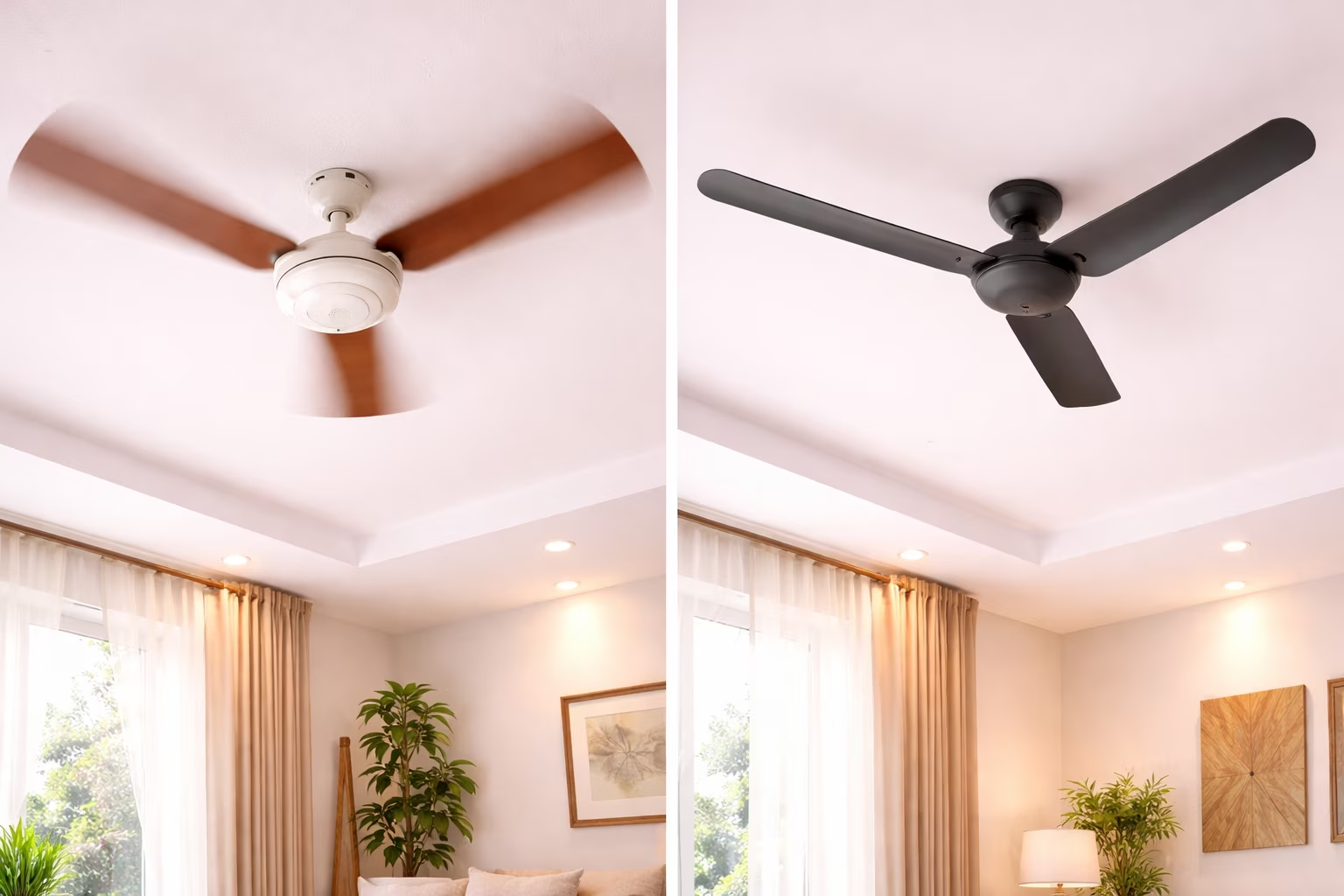
- A standard induction ceiling fan uses 70 to 80 watts. A 5-star BLDC fan uses 28 to 35 watts at top speed. That is a 50 to 65% reduction in power consumption per fan.
- At 12 hours of daily use and Rs 7 per unit, one BLDC fan saves Rs 1,100 to Rs 1,500 per year. Replace four fans in a 2BHK and the annual saving is Rs 4,400 to Rs 6,000.
- The saving is larger than most guides show because both fans are compared at maximum speed. At speed 3 (typical use), a BLDC fan uses 12 to 15 watts versus 50 watts for a standard fan. The proportional gap widens at lower speeds.
- For homes with power cuts, BLDC fans on a home inverter give 2 to 3 times more backup hours than a standard induction fan drawing the same battery.
The question of BLDC fan vs normal fan comes down to one number: how many hours a day does your fan run? If the answer is more than 8 hours, the upgrade pays for itself in under two years. If the answer is closer to 15 hours during Indian summers, it pays back in under a year. The math is straightforward. What most guides get wrong is using a flat electricity rate for India, ignoring slab-based tariffs, and comparing both fans only at maximum speed.
This guide does the calculation properly: real wattage at real use speeds, India’s actual tariff structure, a room-by-room payback table, and the inverter angle that most buying guides miss entirely.
In This Article
The Actual Wattage Numbers
Most BLDC vs normal fan comparisons quote maximum speed figures: 75W versus 28W. That is accurate but incomplete. Indian fans spend most of their runtime at speed 3 or 4, not speed 5. The comparison at typical use speeds matters far more for real annual savings.
| Fan Speed | Standard Induction Fan (W) | BLDC 5-Star Fan (W) | Saving per Hour |
|---|---|---|---|
| Speed 1 (lowest) | ~25W | ~3 to 5W | ~20W |
| Speed 2 | ~35W | ~6 to 8W | ~28W |
| Speed 3 (typical use) | ~50W | ~12 to 15W | ~37W |
| Speed 4 | ~62W | ~20 to 24W | ~40W |
| Speed 5 (max) | ~75W | ~28 to 35W | ~43W |
At speed 3, a standard fan uses roughly four times the power of a BLDC fan at the same setting. For a fan running through the night at speed 3, the saving is substantially larger than the maximum-speed headline figure suggests.
Tip
If you use a regulator to run your standard fan at lower speeds, the saving from switching to BLDC is even larger. Electronic regulators on induction fans reduce speed by reducing voltage, causing the motor to draw current inefficiently. A BLDC fan’s controller reduces speed by adjusting motor drive frequency, which is far more efficient at every setting.
The Savings Math for Indian Homes
India does not have a flat electricity rate. Residential tariffs follow a slab system: the first 100 units per month cost less per unit than the next 200, and higher consumption pushes into progressively costlier slabs. The value of the electricity a BLDC fan saves depends entirely on which slab your household already sits in.
| City | Low Slab (0 to 100 units/month) | Mid Slab (100 to 300 units/month) | High Slab (300+ units/month) |
|---|---|---|---|
| Delhi | Rs 0 to Rs 3/unit (subsidised) | Rs 4.50/unit | Rs 6.50 to Rs 8/unit |
| Mumbai (Tata/Adani) | Rs 2 to Rs 4/unit | Rs 5.50 to Rs 6/unit | Rs 7 to Rs 12/unit |
| Bengaluru (BESCOM) | Rs 3.70/unit | Rs 5.75/unit | Rs 7.10 to Rs 8.30/unit |
| Most Tier 2 cities | Rs 3 to Rs 4/unit | Rs 5 to Rs 6/unit | Rs 7 to Rs 9/unit |
For households already in the middle or upper slab, which covers most 2BHK and 3BHK homes running ACs, washing machines, and multiple fans, the electricity saved by a BLDC fan is priced at Rs 6 to Rs 9 per unit, not Rs 4. This materially changes the savings figure. The numbers below use Rs 7/unit as a conservative mid-range for city households consuming 200 to 400 units per month.
| Usage Scenario | Daily Hours | Standard Fan / Year | BLDC Fan / Year | Annual Saving (Rs 7/unit) | Annual Saving (Rs 9/unit) |
|---|---|---|---|---|---|
| Light (guest room, study) | 4 hrs | ~110 units | ~41 units | ~Rs 483 | ~Rs 621 |
| Moderate (bedroom) | 10 hrs | ~274 units | ~102 units | ~Rs 1,204 | ~Rs 1,548 |
| Heavy (living room, summer) | 16 hrs | ~438 units | ~164 units | ~Rs 1,925 | ~Rs 2,466 |
Quick Fact
Replace four fans in a 2BHK apartment running an average of 10 hours a day and the total annual saving is approximately Rs 4,800 at Rs 7/unit. At Rs 9/unit (upper slab in Mumbai or Bengaluru), that rises to Rs 6,200 per year. The four replacement fans cost roughly Rs 6,000 extra over standard fans. Payback: under 15 months.
Room-by-Room Payback Table
A BLDC fan costs approximately Rs 1,200 to Rs 1,800 more than a comparable standard fan. The upgrade makes a clear financial case for some rooms and is marginal for others.
| Room | Typical Daily Use | Annual Saving | Payback Period | Recommendation |
|---|---|---|---|---|
| Master bedroom | 10 to 14 hrs | Rs 1,200 to Rs 1,680 | 9 to 15 months | Upgrade now |
| Living room | 14 to 18 hrs | Rs 1,680 to Rs 2,160 | 7 to 11 months | Upgrade now, strongest case |
| Children’s room | 8 to 12 hrs | Rs 960 to Rs 1,440 | 10 to 18 months | Upgrade now |
| Kitchen / utility | 4 to 6 hrs | Rs 480 to Rs 720 | 20 to 30 months | Upgrade when old fan fails |
| Guest room | 1 to 3 hrs | Rs 120 to Rs 360 | 40 to 120 months | Not worth upgrading |
| Balcony / passage | 1 to 2 hrs | Rs 120 to Rs 240 | 60 to 120 months | Not worth upgrading |
The Inverter Angle: Why It Matters Beyond the Bill
Most buying guides focus entirely on the electricity bill saving and miss the operational benefit for Indian homes that face regular power cuts. A standard induction fan connected to a home inverter draws 75 to 80 watts from the battery. A BLDC fan draws 28 to 35 watts. On a standard 150Ah inverter battery, this difference is significant.
| Load | Fan Type | Total Draw (2 fans) | Backup on 150Ah Battery |
|---|---|---|---|
| 2 ceiling fans only | Standard induction | ~150W | ~6 to 7 hours |
| 2 ceiling fans only | BLDC 5-star | ~60W | ~14 to 16 hours |
| 2 fans + 1 tube light | Standard induction | ~190W | ~5 hours |
| 2 fans + 1 tube light | BLDC 5-star | ~100W | ~9 to 10 hours |
For Tier 2 and Tier 3 cities where 4 to 8 hour power cuts in summer are common, this is the primary reason to upgrade. The electricity bill saving is the secondary one.
Important
Most BLDC fans run on standard 230V AC, which an inverter provides. However, some premium models (Atomberg Efficio+, certain Havells variants) have built-in voltage tolerance down to 140V, preventing the motor stutter common with cheaper inverters whose output voltage drops under load. Worth checking the spec sheet if your inverter is an older model.
What the BEE Star Rating Actually Tells You
Since January 2023, all ceiling fans sold in India must carry a mandatory BEE star rating. This sounds like a reliable comparison tool, but it contains one nuance most buyers miss: both BLDC fans and improved induction fans can reach 5-star ratings, but their absolute power consumption is very different. A 5-star induction fan might consume 50 watts while a 5-star BLDC fan consumes 28 watts. Both carry identical star labels.
The BEE star rating measures Service Value: air delivery (cubic metres per minute) divided by power consumption (watts). It tells you how efficiently a fan moves air, not what its absolute wattage is. A fan that moves a large volume of air at moderate power can score 5 stars even if its wattage is higher than a smaller, more efficient fan.
Tip
Always check the wattage figure printed on the BEE label, not just the star count. A 5-star BLDC fan at 28W and a 5-star induction fan at 50W carry the same stars but cost very different amounts to run. The wattage is on the label. Use it.
Which Fans Are Worth Upgrading and Which Are Not
- Upgrade immediately: Bedroom, living room, and any fan running more than 10 hours a day. Payback is under 18 months in almost every scenario.
- Upgrade when the old fan fails: Kitchen and utility fans running 4 to 6 hours daily. The saving is real but payback stretches to 2 to 3 years. Make the BLDC choice at replacement time.
- Not worth replacing: Guest room and passage fans used less than 3 hours a day. Payback period exceeds 4 years. Keep the standard fan until it fails.
- Upgrade regardless of hours if you have power cuts: Any fan on an inverter circuit. The battery backup benefit alone justifies the upgrade even at low daily usage.
FAQs
How Much Does a BLDC Fan Actually Save per Month?
At 10 hours of daily use and Rs 7/unit, a single BLDC fan saves approximately Rs 100 per month versus a standard fan. At 16 hours in peak summer, the saving rises to Rs 160 per month per fan. Four fans in a 2BHK save Rs 400 to Rs 640 per month in summer months.
Are All BLDC Fans the Same Quality?
No. Wattage ranges from 28 to 35W across most 5-star BLDC fans, but air delivery, noise, remote quality, and motor longevity vary significantly. Atomberg and Havells are the most consistently reviewed. Crompton’s BLDC range and Orient’s Aeroslim are also well-regarded. Budget BLDC fans under Rs 2,000 often have inferior electronic controllers that reduce lifespan and efficiency.
Do BLDC Fans Work With Standard Dimmer Regulators?
No. Standard dimmer or resistive regulators do not work with BLDC fans and can damage the motor controller. BLDC fans come with their own remote or capacitive touch regulator. This replaces the wall regulator permanently and is included in the box with most branded models.
Is the Air Throw of a BLDC Fan Comparable to a Standard Fan?
Yes. A 5-star BLDC fan delivers comparable or better air throw than a standard fan at the same sweep size. The motor controller optimises rotation more precisely than a capacitor-driven induction motor. Most users also report BLDC fans are quieter at higher speeds because there is no capacitor hum.
What Happens to a BLDC Fan During Voltage Fluctuations?
Most BLDC fans handle voltage fluctuations better than standard induction fans because the electronic controller regulates the motor drive independently of input voltage variation. Most models operate stably between 140V and 270V, making them more suitable for Tier 2 and Tier 3 cities where voltage fluctuation is common during peak load hours.