
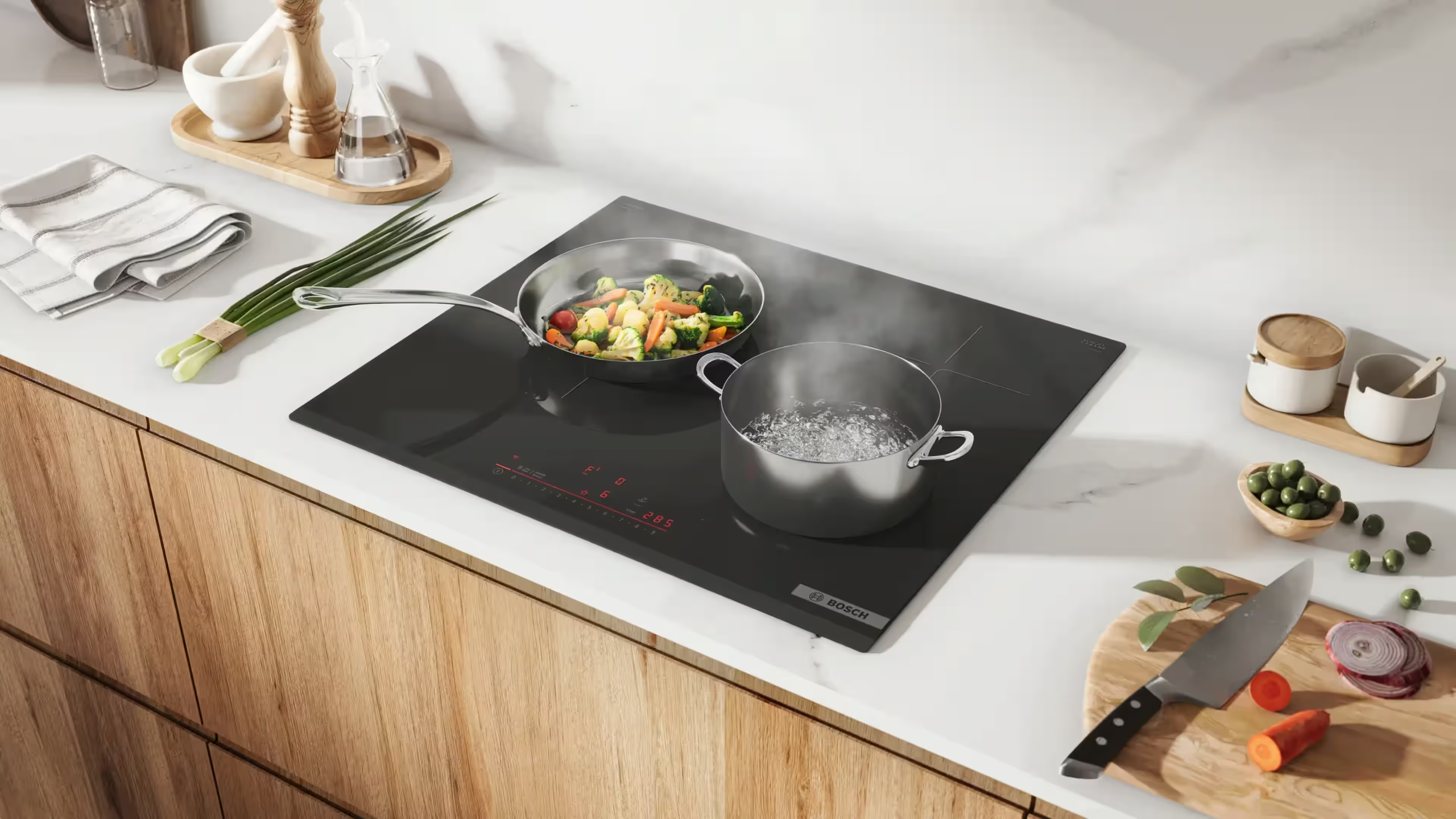
- An induction cooktop is 90% energy efficient compared to roughly 40% for a gas stove. A family cooking 2 to 3 hours daily saves Rs 500 to Rs 900 per month over LPG at current cylinder prices.
- The sweet spot for Indian cooking is 2000W to 2200W. Below 1800W is adequate only for singles or backup use. Indian-specific features to prioritise: whistle counter, automatic voltage regulation, and dedicated Indian presets.
- Most home inverters (800VA to 1500VA) cannot run a 2000W induction cooktop. A minimum 3kVA inverter is required. Induction is grid-dependent; keep a gas backup for power cuts.
- Traditional aluminium kadai, copper vessels, and clay pots do not work on induction. Cast iron and magnetic stainless steel do. Run a fridge magnet test on your existing cookware before buying.
Switching to an induction cooktop is one of the most practical eco upgrades an Indian kitchen can make in 2026: faster boiling, a cooler kitchen in summer, no indoor combustion gases, and a monthly electricity bill that is consistently lower than LPG costs. The question is not whether to switch, but which model actually handles dal, pressure cooking, and dosa without frustrating you.
This guide covers the actual running cost numbers for induction vs gas stove in India, the four best induction cooktops for Indian cooking across price ranges, what your current cookware will and will not work with, and the two practical questions most buying guides skip entirely: whether your home inverter can run it, and whether your kitchen wiring is rated for it.
In This Article
- Why induction makes sense for an Indian kitchen
- Running cost: induction vs LPG by the numbers
- What to check before you buy
- The 4 best induction cooktops for Indian cooking
- Cookware compatibility: what works and what does not
- The inverter question: honest answer
- Before you install: wiring and socket check
- FAQs
Why Induction Makes Sense for an Indian Kitchen
A gas stove transfers only about 40% of the energy from the flame to your food. The rest heats the air around the vessel, the grate, and ultimately your kitchen. An induction cooktop transfers approximately 90% of electrical energy directly into the cookware through electromagnetic induction, which means less energy is wasted and the kitchen itself stays significantly cooler. In summer months across most of India, this is not a minor benefit: eliminating combustion heat from a 1,200 sq ft flat makes a measurable difference to room temperature and therefore to air conditioning load.
There is also the indoor air quality argument. Gas combustion releases carbon dioxide, nitrogen dioxide, and particulate matter directly into the kitchen. A 2024 study published in the International Journal of Environmental Research and Public Health linked gas stove use to elevated indoor NO2 levels associated with respiratory issues, particularly in small, poorly ventilated Indian kitchens. Induction produces no combustion byproducts. The surface itself does not get hot except from contact with the vessel, which also means spills do not bake on and the glass wipes clean in seconds.
Quick Fact
Induction boils six cups of water in approximately 5 minutes. A standard high-flame gas burner takes roughly 8 minutes for the same task. Faster cooking means the appliance is on for less time per meal, which reduces actual electricity consumption below the theoretical maximum wattage figure.
Running Cost: Induction vs LPG by the Numbers
As of late 2025 and into 2026, a 14.2 kg domestic LPG cylinder costs approximately Rs 853 in Delhi, with prices varying by city and subsidy status. A household cooking 2 to 3 hours daily consumes 1.5 to 2 cylinders per month, translating to Rs 1,280 to Rs 1,818 per month on LPG. A 2000W induction cooktop running 2 hours daily consumes 4 units (kWh) per day, or 120 units monthly. At Rs 6 to Rs 8 per unit (mid to upper tariff slab in most Indian cities), monthly electricity cost is Rs 720 to Rs 960.
| Cooking Method | Monthly Cost | Annual Cost | Efficiency | Works in Power Cut? |
|---|---|---|---|---|
| LPG gas stove (1.5 to 2 cylinders) | Rs 1,280 to Rs 1,818 | Rs 15,360 to Rs 21,816 | ~40% | Yes |
| 2000W induction, 2 hrs/day (Rs 7/unit) | Rs 720 to Rs 960 | Rs 8,640 to Rs 11,520 | ~90% | No (see inverter section) |
| Monthly saving on induction | Rs 500 to Rs 900 | Rs 6,000 to Rs 10,800 |
A quality induction cooktop costs Rs 2,500 to Rs 5,000. At a conservative saving of Rs 500 per month, the appliance pays for itself in 5 to 10 months. For families in the upper electricity tariff slab (300+ units/month), who pay Rs 8 to Rs 12 per unit, induction savings are even more significant because you are displacing LPG costs with electricity from a slab you are already paying into.
Important
These figures assume induction as the primary cooking method. If you are using induction only as a backup alongside LPG, the savings are proportionally smaller. The payback calculation is most favourable for households who commit to induction for daily cooking and retain gas only for power cuts or direct-flame dishes like roti and dosa.
What to Check Before You Buy
Five things that matter specifically for Indian cooking conditions, beyond the basic spec sheet.
1. Wattage: 2000W to 2200W for Daily Family Cooking
For a family of three or more cooking two full meals daily, do not buy anything under 1800W. The 2000W to 2200W range is where deep-frying puris, boiling large pots of water, and maintaining a rolling boil for biryani become practical. An 1800W model is adequate for a single person or as a light backup appliance. The Pigeon Cruise at 1800W and the Prestige PIC 3.1 V3 at 2000W mark the two ends of the budget tier.
2. Whistle Counter: Essential for Pressure Cooker Households
If pressure cooking is a daily activity (dal, rice, or sabzi), a whistle counter is the single most useful Indian-specific feature on an induction cooktop. It listens for the pressure cooker’s whistles and automatically drops to a keep-warm setting after the required count, preventing overcooking without you standing next to the stove. The Prestige PIC 6.1 V3 has an automatic whistle counter. The Hawkins Futura has a manual “after whistle” button that achieves the same result with one tap.
3. Automatic Voltage Regulation for Tier 2 and Tier 3 Cities
Indian home voltage ranges from 180V to 260V in many areas, particularly during peak load hours in summer. Budget induction cooktops rated for 220V to 240V can have their control boards damaged by sustained low voltage. Models with a built-in automatic voltage regulator (AVR) handle this range without external stabilisers. The Prestige PIC 6.1 V3 includes AVR and 4kV surge protection. If you are in a Tier 2 or Tier 3 city with known voltage fluctuations, treat AVR as a non-negotiable requirement rather than a premium feature.
4. Preset Menus: Useful but Check Which Ones
Indian preset menus vary in usefulness between brands. Milk Boil, Dosa/Roti, and Curry/Gravy presets genuinely save time and reduce spill incidents. Presets labelled “Indian Menu 1, 2, 3” without specific temperature mapping are marketing decoration. Check that the model has at minimum a dedicated milk boil preset that cuts off at 80 to 85 degrees to prevent the notorious induction milk overflow, a low simmer for curries, and a high boil for pressure cooking.
5. Cooling Vent Placement: Check Before Installing
A 2000W+ induction unit generates significant heat in its electronics and requires a built-in cooling fan. Models with rear vents need at least 10 cm of clearance from the wall. Models with bottom vents must not be placed on soft kitchen mats that block airflow. Check vent placement before deciding where the cooktop will sit on your counter.
The 4 Best Induction Cooktops for Indian Cooking
Best Overall: Philips Viva HD4928/01 (2100W)
The Philips HD4928/01 has been the most consistently recommended induction cooktop for Indian families for several years and remains the top pick in 2026. The 2100W full crystal glass model runs 6 optimised Indian presets including Roti/Dosa, Gravy, and Slow Cook with Smart Sense vessel detection. It includes child lock, auto shut-off, and voltage protection. The crystal glass surface resists scratches more effectively than standard tempered glass. Available at Rs 3,699 to Rs 4,999, it is the most straightforward recommendation for a family of 3 to 5 cooking daily.
Best for Heavy Indian Cooking: Prestige PIC 6.1 V3 (2200W)
At 2200W with a patented automatic whistle counter, the Prestige PIC 6.1 V3 is designed specifically for the pressure-cooker-heavy Indian cooking pattern. It includes an automatic voltage regulator, anti-magnetic wall technology, dual heat sensors, and 4kV surge protection across 7 preset Indian menus. Priced at Rs 2,500 to Rs 3,500, the feature set is exceptional for the price. The primary trade-off is build quality: the plastic body and controls feel less premium than Philips. For daily heavy-duty use in a large household, the whistle counter and AVR combination makes it the more practical choice.
Best Precision Control: Hawkins Futura FIC1A1 (2000W)
The Hawkins Futura is the only Indian-market induction cooktop with 20 granular power settings from 100W to 2000W in 100W steps. This means you can hold a gentle simmer at 200W for slow-cooked gravies without the on-off cycling that causes temperature fluctuations in cheaper models. A dedicated After Whistle button drops the cooktop to exactly 400W when pressed. It also has a Pause function that holds all settings while you step away. Priced at Rs 3,390 to Rs 4,950, it is the right choice for anyone who cooks multiple dishes with precise heat requirements.
Best Budget Under Rs 2,000: Pigeon Cruise (1800W)
The Pigeon Cruise delivers 1800W with a 93% energy efficiency rating, 7-segment LED display, basic Indian presets, and standard safety features at Rs 1,039 to Rs 1,250. It is the right buy for a single person, a hostel room, or as a supplementary second-burner cooktop. For a family making daily dal and sabzi, 1800W becomes a limitation for deep-frying or fast boiling large volumes. Buy the Pigeon Cruise for light use; move to the Prestige or Philips for primary daily family cooking.
| Model | Wattage | Price (approx) | Standout Feature | Best For |
|---|---|---|---|---|
| Philips Viva HD4928/01 | 2100W | Rs 3,699 to Rs 4,999 | Crystal glass, Smart Sense, 6 Indian presets | Best overall, family of 3 to 5 |
| Prestige PIC 6.1 V3 | 2200W | Rs 2,500 to Rs 3,500 | Auto whistle counter, AVR, 4kV surge protection | Heavy cooking, Tier 2/3 cities, pressure cooker use |
| Hawkins Futura FIC1A1 | 2000W | Rs 3,390 to Rs 4,950 | 20 power levels (100W steps), After Whistle button | Precise cooking, advanced home cooks |
| Pigeon Cruise | 1800W | Rs 1,039 to Rs 1,250 | 93% efficiency, BIS certified, 7 presets | Budget, singles, light use or backup |
Cookware Compatibility: What Works and What Does Not
Induction generates heat by creating a rapidly alternating magnetic field that induces electrical currents inside the base of a ferromagnetic vessel. If the vessel base is not ferromagnetic, no current is induced, no heat is generated, and the cooktop displays an E0 error. This is not a fault; it is the system working correctly.
| Cookware Type | Works on Induction? | Notes |
|---|---|---|
| Cast iron kadai, tawa, skillet | Yes, excellent | Retains heat well; ideal for dosa, searing, slow cooking |
| Magnetic stainless steel (triply) | Yes | Most modern stainless steel from Prestige, Hawkins, Vinod is induction compatible |
| Hard anodised aluminium | No (unless has induction base) | Very common in Indian kitchens; will not work without a bonded steel base |
| Plain aluminium kadai | No | Traditional Indian kadai; will not work on induction |
| Copper-bottomed vessels | No | Copper is not ferromagnetic |
| Clay or earthen pots | No | Use gas or infrared cooktop for clay pot cooking |
| Non-stick pans with induction base | Yes | Check for induction coil symbol on base; most premium non-stick pans now include it |
| Borosil or ceramic glass | No | Not ferromagnetic |
Tip
Hold a standard fridge magnet to the base of any vessel you own. If the magnet sticks firmly, the vessel is induction compatible. If it slides off or barely holds, it will not work. Replacing a full set of aluminium cookware with magnetic stainless steel or cast iron typically costs Rs 3,000 to Rs 8,000 and should be factored into your total switching cost alongside the cooktop price.
The Inverter Question: Honest Answer
The most commonly asked question about induction cooktops in India is whether they can run on a home inverter during power cuts. The honest answer is: not on a standard home inverter, and here is why.
A 2000W induction cooktop draws approximately 9 to 10 amps at 220V. Most Indian home inverters are rated at 800VA to 1500VA, which translates to a usable load of 640W to 1,200W. A 2000W appliance exceeds this load limit and will either trip the inverter’s overload protection or, in cheap inverters, damage the output circuitry. To reliably run a 2000W induction cooktop on inverter, you need a minimum 3kVA inverter (2,400W usable capacity), paired with a battery bank large enough to sustain that draw. A standard 150Ah lead acid battery at 2000W load would be depleted in under 1 hour.
Important
There is a partial workaround: some induction models allow operation at 300W to 600W on their lowest power settings. At 300W, a larger home inverter (1500VA) can technically sustain the load for warming or very slow cooking. But this is not a cooking solution for power cuts; it is barely enough to heat milk. For power cut cooking, retain a gas connection or a portable gas stove as your backup. The induction cooktop is your primary option, not your emergency one.
Before You Install: Wiring and Socket Check
A 2000W induction cooktop requires a dedicated 16-amp socket with proper three-pin earthing. The majority of Indian kitchen counters, particularly in older apartments and homes built before 2010, have 5-amp or 6-amp sockets designed for mixers, grinders, and small appliances. Running a 2000W load through a 5A socket and wiring is a fire hazard: the wiring will overheat, the socket will eventually char, and in the worst case the wiring insulation fails inside the wall.
- Check your socket rating: A 16A socket is physically larger than a standard 6A socket and accepts 3-pin plugs with thicker pins. If your kitchen has only 6A sockets, you need an electrician before you install an induction cooktop.
- Check your MCB (circuit breaker): The kitchen circuit should be protected by at least a 20A MCB. A 16A MCB will trip regularly under sustained 2000W load.
- Earthing is mandatory: Induction cooktops are Class I appliances requiring earthing for safe operation. If your flat does not have a functioning earth connection (common in older buildings), get it tested and corrected. An electrician visit costs Rs 500 to Rs 1,500 and is the cheapest insurance for a Rs 4,000 appliance.
- Aluminium wiring in older homes: Homes built in the 1970s and 1980s in many Indian cities used aluminium wiring, which has lower current capacity than copper. If your home has aluminium wiring, consult an electrician before adding any high-wattage appliance to the circuit.
FAQs
Which Induction Cooktop Is Best for Daily Indian Cooking?
For a family of 3 to 5 cooking two full meals daily, the Philips Viva HD4928/01 (2100W) is the most reliable all-round choice for build quality, service network, and Indian preset performance. If pressure cooking dal and rice every day is the primary use case, the Prestige PIC 6.1 V3 (2200W) with its automatic whistle counter is the more practical option and costs Rs 1,000 to Rs 1,500 less.
Is Induction Cheaper Than Gas in India?
For most households cooking 2 to 3 hours daily, yes. A family spending Rs 1,280 to Rs 1,818 per month on LPG will spend Rs 720 to Rs 960 per month on electricity for equivalent induction cooking. Monthly saving is Rs 500 to Rs 900. At Rs 500 per month saving, a Rs 4,000 induction cooktop pays back in 8 months. The saving is larger for households already in the middle or upper electricity tariff slab, since the marginal cost of additional electricity is lower than LPG per equivalent unit of cooking energy.
Can I Use My Existing Kadai on an Induction Cooktop?
It depends on the material. Traditional aluminium kadai will not work. Hard anodised aluminium kadai will not work unless it has a bonded induction base. Cast iron kadai works excellently. Magnetic stainless steel kadai (test with a fridge magnet on the base) works. Run the fridge magnet test on your existing cookware before buying; if most of it is aluminium, budget Rs 3,000 to Rs 6,000 for compatible replacements alongside the cooktop cost.
What Does the E0 Error Mean on an Induction Cooktop?
E0 is the auto-pan detection signal. It means the cooktop cannot detect a compatible magnetic vessel on the surface. This triggers when no vessel is placed, an incompatible vessel (aluminium, copper, clay) is placed, or the vessel base is smaller than the minimum diameter (usually 12 cm). Replace the vessel with a compatible magnetic one and the error clears immediately. It is a safety feature, not a malfunction.
What Is the Difference Between Induction and Infrared Cooktop?
An induction cooktop heats only ferromagnetic vessels through electromagnetic induction and the surface itself stays relatively cool. An infrared cooktop uses a radiant heating element beneath a glass surface that heats any flat-bottomed vessel regardless of material, including aluminium and clay. Infrared is the right choice if you want to keep using your existing aluminium or non-magnetic cookware. The trade-offs are lower efficiency (60 to 70% compared to 90% for induction) and a hot-to-the-touch surface that is less safe around children.