
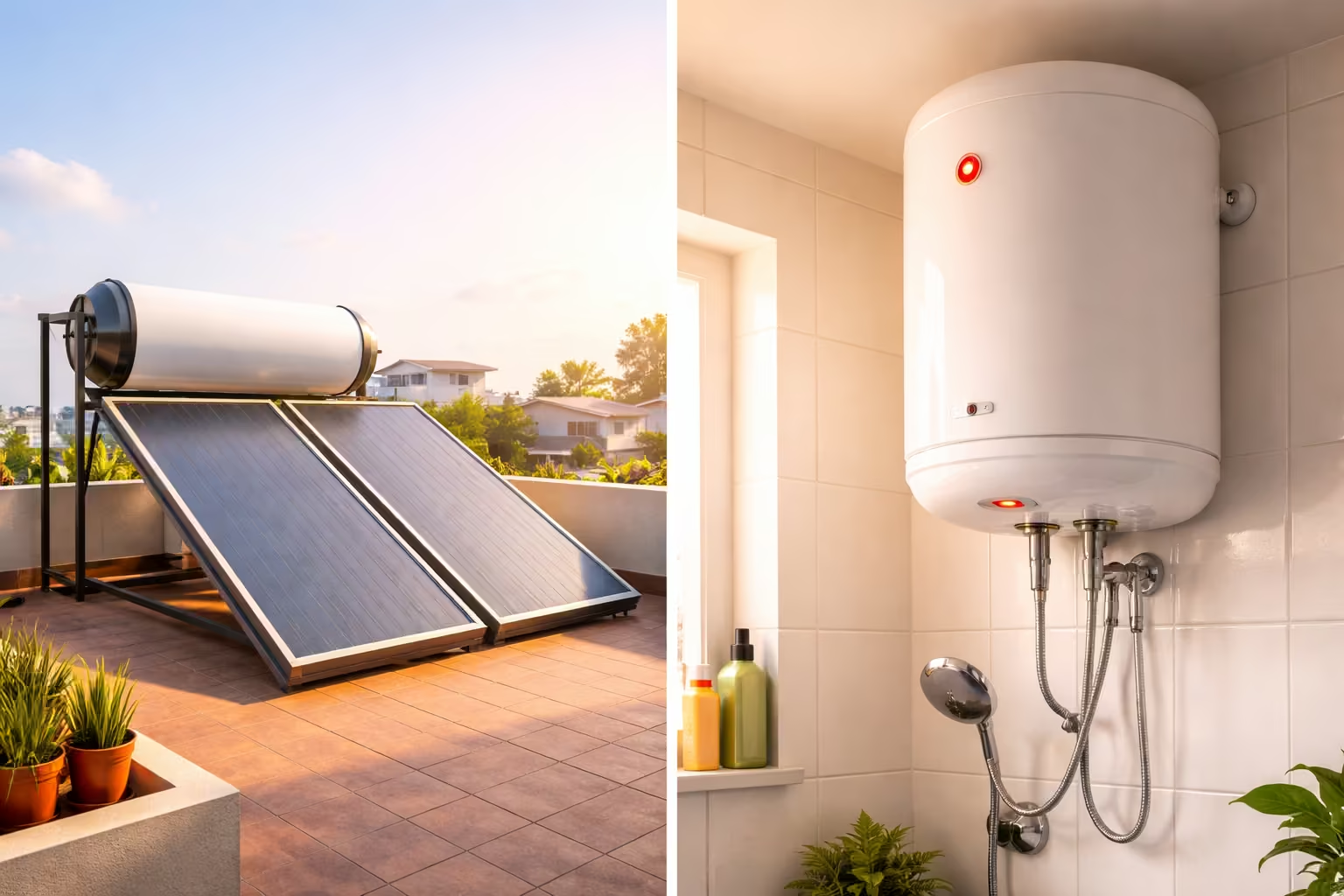
- A thermostat-controlled 25L electric geyser uses 1.5 to 2.5 units per day for a family of four in winter, not the 3-unit figure many solar vendor comparisons use. Annual running cost is Rs 3,500 to Rs 6,500 per year.
- An ETC solar water heater (100 LPD) costs Rs 18,000 to Rs 32,000 all-in and pays back in 3 to 6 years depending on tariff slab and usage months. Over 10 years, the total saving over an electric geyser is Rs 15,000 to Rs 70,000.
- ETC and FPC are two different technologies. ETC is better for North India, cold climates, and hard water. FPC is better for South India and consistently sunny regions but needs maintenance in high-TDS cities.
- The MNRE PM Surya Ghar subsidy covers rooftop solar PV, not standalone solar water heaters. State-level water heater subsidies exist but are intermittent. Verify directly with your DISCOM before including any subsidy in your calculation.
Choosing between a solar water heater vs electric geyser in India is essentially a question of how long you plan to stay in your home. In the first year, the electric geyser wins on cost. By year three, the solar water heater has usually broken even. Over ten years, the difference in total spending between the two options is often Rs 60,000 to Rs 80,000 per household. This guide runs the full numbers, including the costs most comparison articles skip: hard water maintenance, realistic geyser consumption, and the actual state of government subsidies in 2026.
The solar water heater vs electric geyser calculation is not one-size-fits-all. It depends on your city’s sunshine hours, your water’s TDS level, your electricity tariff slab, and whether you have roof access. All of those variables are accounted for below.
In This Article
How Much Does an Electric Geyser Actually Cost to Run
The most common mistake in geyser running cost estimates is confusing the rated power of a geyser with its actual daily consumption. A 25-litre geyser rated at 2,000 watts heats a cold tank to thermostat temperature in approximately 20 to 35 minutes, then cycles on and off to maintain temperature. Actual daily consumption for a family of four using a 25L geyser for morning baths is closer to 1.5 to 2.5 units per day in winter, not the 3-unit figure commonly cited.
| Usage Pattern | Geyser Rating | Daily Units | Monthly Cost (Rs 7/unit) | Monthly Cost (Rs 9/unit) |
|---|---|---|---|---|
| Single person, 10L geyser | 2,000W | ~0.6 to 0.8 | Rs 126 to Rs 168 | Rs 162 to Rs 216 |
| 2-person household, 15L geyser | 2,000W | ~0.8 to 1.2 | Rs 168 to Rs 252 | Rs 216 to Rs 324 |
| 4-person household, 25L geyser | 2,000W | ~1.5 to 2.5 | Rs 315 to Rs 525 | Rs 405 to Rs 675 |
| 4-person, older geyser (no thermostat) | 2,000 to 3,000W | ~2.5 to 4 | Rs 525 to Rs 840 | Rs 675 to Rs 1,080 |
Annual geyser running cost for a typical 4-person household using a thermostat-controlled 25L geyser is Rs 3,500 to Rs 6,500 per year. Solar vendor comparisons that use Rs 12,000 to Rs 18,000 as the annual baseline are inflating the figure to make the solar payback look faster than it is.
Tip
A BEE 5-star rated geyser reduces standby heat loss by up to 30% compared to a 3-star model. For an apartment household with no roof access, upgrading from a 3-star to a 5-star geyser saves Rs 800 to Rs 1,500 per year at current tariffs. The 5-star model costs Rs 1,000 to Rs 2,500 more upfront. Payback: 12 to 18 months.
Solar Water Heater: Upfront Cost and What You Get
A solar water heater is not a single product. Two fundamentally different technologies are sold under the same name in India, and the choice between them affects your cost, performance in your climate, and long-term maintenance in ways most buyers discover only after installation.
ETC: Evacuated Tube Collector
ETC systems use vacuum-sealed glass tubes, each containing a copper heat pipe. The vacuum insulation means they retain heat even in cold and cloudy conditions, making them the better choice for North India, hilly regions, and areas with unpredictable winter sunshine. They start at Rs 15,000 to Rs 28,000 for a 100 LPD system. Individual tubes can break but are cheap to replace. ETC systems also handle hard water better because water does not flow directly through the glass; it passes through a copper manifold instead.
FPC: Flat Plate Collector
FPC systems use a flat panel with copper pipes running through an insulated absorber plate. They are more durable, more compact, and better suited to consistently sunny warm regions like South India, Rajasthan, and Gujarat. They cost more (Rs 25,000 to Rs 45,000 for 100 LPD) and are heavier. The main vulnerability is hard water: minerals scale inside the copper pipes over time. In cities with TDS above 500 ppm, FPC systems need a water softener or periodic descaling.
| Factor | ETC System | FPC System |
|---|---|---|
| 100 LPD price | Rs 15,000 to Rs 28,000 | Rs 25,000 to Rs 45,000 |
| 200 LPD price | Rs 25,000 to Rs 40,000 | Rs 40,000 to Rs 70,000 |
| Best climate | Cold, hilly, cloudy regions | Warm, consistently sunny regions |
| Hard water tolerance | Better (water does not touch tubes) | Moderate (copper pipes can scale) |
| Durability | Glass tubes can break individually | More durable overall |
| Maintenance | Replace broken tubes individually | Descale pipes every 2 to 3 years in hard water areas |
| Lifespan | 15 to 20 years | 20 to 25 years |
| Best for | North India, hills, budget buyers | South India, Gujarat, Rajasthan |
Quick Fact
ETC systems offer up to 163% better thermal efficiency than FPC in cold or cloudy conditions. In warm and consistently sunny climates both types perform similarly, but FPC systems are generally easier to maintain long-term in those conditions.
Solar Water Heater vs Electric Geyser: Full Cost Comparison Over 10 Years
The real comparison is total cost of ownership: purchase, installation, running cost, and maintenance over the usable life of each system. The table below uses a 4-person household, 25L geyser equivalent, with winter usage in a North Indian city at Rs 7/unit.
| Cost Item | Electric Geyser (25L, 5-star) | ETC Solar (100 LPD) | FPC Solar (100 LPD) |
|---|---|---|---|
| Purchase price | Rs 8,000 to Rs 12,000 | Rs 18,000 to Rs 28,000 | Rs 30,000 to Rs 45,000 |
| Installation | Rs 500 to Rs 1,000 | Rs 2,000 to Rs 4,000 | Rs 3,000 to Rs 6,000 |
| Annual running cost | Rs 4,000 to Rs 6,500 | Rs 0 to Rs 600 | Rs 0 to Rs 600 |
| 10-year running cost | Rs 40,000 to Rs 65,000 | Rs 0 to Rs 6,000 | Rs 0 to Rs 6,000 |
| Replacement at year 7 to 10 | Rs 8,000 to Rs 12,000 | None likely | None likely |
| Maintenance over 10 years | Rs 1,000 to Rs 2,000 | Rs 2,000 to Rs 5,000 | Rs 3,000 to Rs 6,000 |
| Total 10-year cost | Rs 57,500 to Rs 96,000 | Rs 22,000 to Rs 43,000 | Rs 36,000 to Rs 63,000 |
Payback Period by Usage and Tariff
Solar water heater payback depends on three variables: system cost, annual electricity saving, and your tariff rate. The table below uses an ETC 100 LPD system at Rs 22,000 all-in as the baseline, compared against a 4-person household with a 25L geyser.
| Usage Scenario | Annual Saving | Payback (Rs 7/unit) | Payback (Rs 9/unit) |
|---|---|---|---|
| 6 months winter use (North India) | Rs 2,700 to Rs 3,200 | 7 to 8 years | 5 to 6 years |
| 8 months winter + monsoon | Rs 3,600 to Rs 4,300 | 5 to 6 years | 4 to 5 years |
| Year-round use (South India) | Rs 4,500 to Rs 6,000 | 3.5 to 5 years | 3 to 4 years |
| Year-round, upper tariff slab | Rs 6,000 to Rs 8,000 | 3 to 4 years | 2.5 to 3 years |
Important
The payback figures assume clear-sky operation on most days. In regions with extended monsoon seasons or persistent winter fog (Delhi in December and January), add 1 to 1.5 years to the payback estimate and ensure your system has an adequately sized electric backup element.
The Hard Water Problem Nobody Mentions
India has some of the hardest municipal water in the world. Cities like Delhi, Hyderabad, Chennai, and parts of Punjab and Rajasthan have TDS levels ranging from 400 to over 1,500 ppm. In electric geysers, scale builds up on the heating element, reducing efficiency and causing early failure. In ETC systems, scale accumulates in the copper manifold. In FPC systems, scale builds inside the copper absorber pipes, which is harder to descale and more damaging to efficiency over time.
| Water TDS Level | Best System Choice | Maintenance Needed |
|---|---|---|
| Below 300 ppm | Either system works well | Standard annual checks |
| 300 to 500 ppm | ETC preferred over FPC | Geyser element check every 3 years; FPC descaling every 2 to 3 years |
| 500 to 800 ppm | ETC strongly preferred | Geyser element replacement at year 4 to 5; FPC needs water softener |
| Above 800 ppm | ETC with heat exchanger model | Annual manifold flush; geyser element every 3 to 4 years |
Tip
In high-TDS cities, ask specifically for an indirect heating or heat exchanger FPC model. A secondary fluid circulates through the collector and transfers heat to your tank without hard water ever entering the collector. These models cost Rs 5,000 to Rs 10,000 more but eliminate the scaling problem entirely.
The MNRE Subsidy: What Is Actually Available in 2026
Many solar vendor websites state that “the government offers subsidies on solar water heaters.” This needs clarification. The current central government flagship solar scheme, PM Surya Ghar: Muft Bijli Yojana, provides subsidies of up to 60% on residential rooftop solar PV installations. It does not cover standalone solar water heaters.
State-level subsidies for solar water heaters do exist but vary considerably and operate on limited annual budgets. Before factoring any subsidy into your cost calculation, verify directly with your state’s energy department or DISCOM, not a vendor’s website.
Quick Fact
Some state DISCOMs offer a reduced electricity tariff for households with a solar water heater installed, recognising the reduction in grid load. In Bengaluru (BESCOM) and some Maharashtra DISCOMs, this has historically translated to a small monthly tariff rebate. Check your DISCOM’s current tariff schedule under the renewable energy or green consumer category.
Who Should Choose What
| Your Situation | Recommended Choice | Why |
|---|---|---|
| Independent house or villa | ETC solar water heater | Fastest payback, lowest 10-year cost, roof access available |
| Top-floor apartment with roof access | ETC solar water heater | Same benefits; verify building society rules before installation |
| Mid-floor apartment, no roof access | BEE 5-star electric geyser | Solar not feasible; 5-star insulation reduces running cost by up to 30% |
| South India (warm, sunny year-round) | FPC solar water heater | Year-round operation maximises payback; FPC suited for warm stable climates |
| North India, hills, cloudy winters | ETC solar water heater | ETC retains heat in cold and overcast conditions |
| Hard water city (Delhi, Hyderabad) | ETC preferred; FPC only with heat exchanger model | Protects collector from scaling; lower maintenance over 10 years |
| Renting or moving within 3 years | BEE 5-star electric geyser | Solar payback needs 3 to 5 years minimum; not viable for short stays |
FAQs: Solar Water Heater vs Electric Geyser
Does a Solar Water Heater Work on Cloudy Days?
Yes, with reduced output. ETC systems retain heat better in overcast conditions than FPC systems. Most solar water heaters sold in India include an electric backup element (typically 1,500 to 2,000W) that activates automatically when solar heating is insufficient. On fully overcast days, you will use this backup and incur normal geyser-level electricity costs for those days only.
What Capacity Does a Family of Four Need?
A 100 LPD system is the standard recommendation for 3 to 4 people. If your household uses more hot water, consider 150 or 200 LPD. Oversizing by 20 to 25% is advisable in North India to account for reduced winter output on cold or overcast days.
How Long Does a Solar Water Heater Last in India?
ETC systems last 15 to 20 years with maintenance. FPC systems last 20 to 25 years. Broken ETC tubes can be individually replaced at Rs 300 to Rs 600 per tube. Electric geysers in India typically last 7 to 10 years before the heating element or tank needs replacement, especially in hard water areas.
Can a Solar Water Heater Be Installed in an Apartment?
Only if you have exclusive or permitted access to a roof with adequate south-facing space and structural load capacity. Most multi-storey societies require written RWA permission. In buildings where multiple residents want solar, a shared rooftop installation with separate tanks per flat is sometimes feasible and worth exploring with a licensed installer.
Is a Solar Water Heater Worth It if I Already Have Solar PV?
Yes. A dedicated solar water heater converts 60 to 80% of solar energy directly to heat. A solar PV panel converts 18 to 22% to electricity, which then powers a geyser at roughly 95% efficiency, giving an end-to-end efficiency of around 17 to 21%. A dedicated solar water heater is significantly more efficient at producing hot water and reserves your PV output for other appliances.