
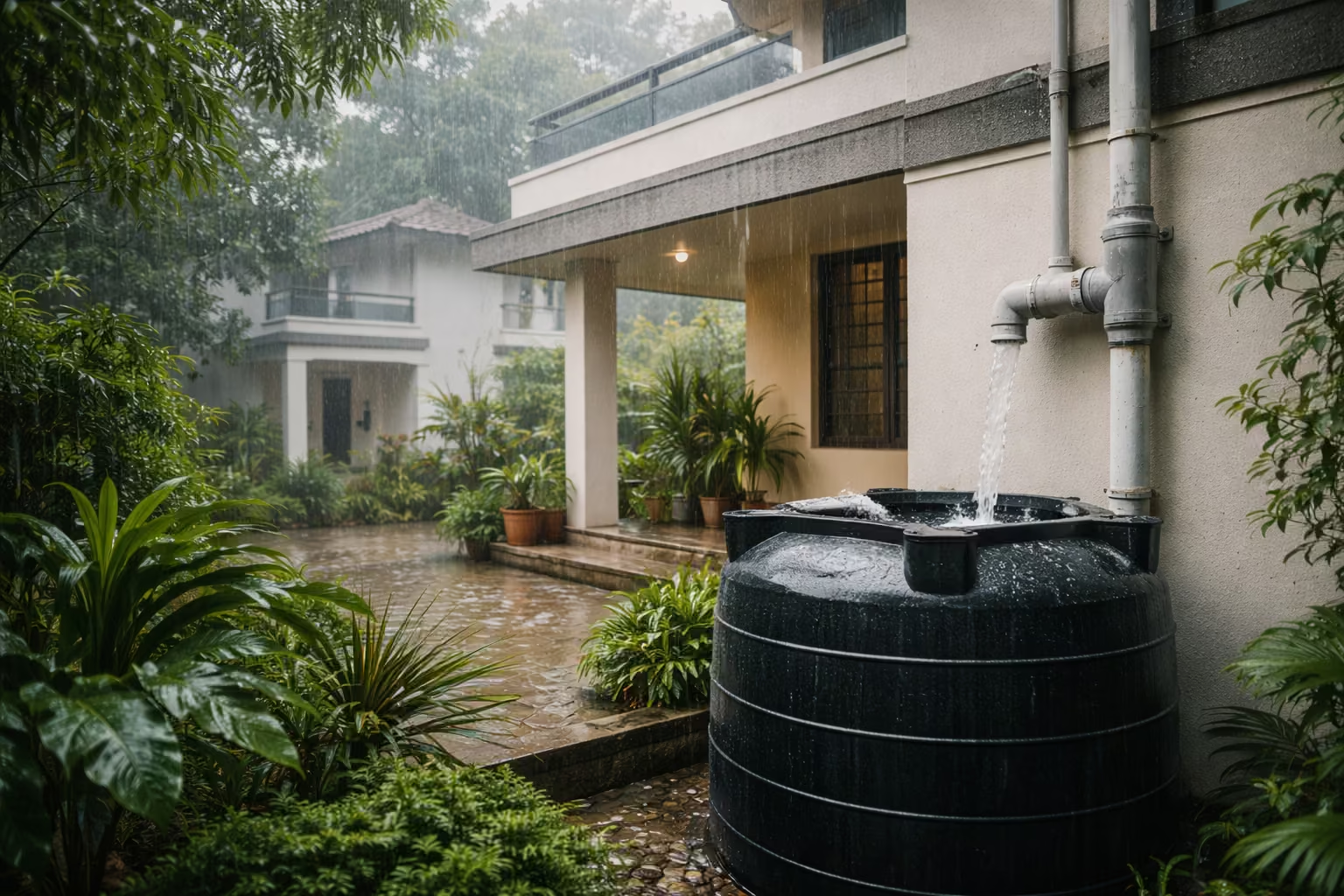
Most Indian cities pump water from depleting aquifers to homes, charge residents for it, and then watch monsoon rainfall drain off rooftops into the nearest storm drain. According to the Central Ground Water Board (CGWB), India extracted 245.64 billion cubic metres of groundwater in 2024, and 730 assessment units across the country are already classified as over-exploited.
The rainfall that lands on your rooftop every monsoon is a free, renewable resource you are currently not using. This guide covers exactly how to capture it: how much water your specific roof can harvest, what a system costs in India, what the law requires in your state, and how to get started this monsoon, whether you own an independent house or live in a flat.
In This Article
- Why rainwater harvesting matters for Indian homes right now
- Storage or groundwater recharge: choose the right goal first
- How to calculate how much water your roof can harvest
- The core components of a rooftop system
- What a rainwater harvesting system costs in India
- Apartments vs. independent houses: how the approach changes
- State-by-state: where rainwater harvesting is mandatory
- How to set up your system step by step
- Monsoon maintenance calendar
- FAQs
Why Rainwater Harvesting Matters for Indian Homes Right Now
India is the world’s largest consumer of groundwater, and the CGWB’s 2025 assessment confirms that 10.80 percent of the country’s 6,762 groundwater assessment units are now over-exploited, meaning extraction exceeds recharge. States like Punjab, Haryana, Delhi, and Rajasthan extract groundwater at rates above 100 percent of their annual recharge capacity. A report by the Economic Advisory Council to the Prime Minister warns that if current trends persist, the rate of groundwater depletion could triple by 2080.
For urban Indian homeowners, this translates into practical, immediate problems. Municipal water supply in cities like Bengaluru, Chennai, and Hyderabad already faces deficits of 20 to 40 percent of demand during summer months. Borewells in many Bengaluru apartment complexes have run dry in the past decade as the water table has dropped. Rainwater harvesting at home does not solve India’s water crisis alone, but it gives your household a degree of water independence that no amount of plumbing investment can provide.
Quick Fact
India receives an average annual rainfall of 1,160 mm, translating to approximately 4,000 billion cubic metres of water reaching the country each year. The CGWB’s 2025 report shows total annual groundwater recharge at 448.52 BCM against extraction of 245.64 BCM nationally, but in over-exploited zones, local deficits are severe.
Storage or Groundwater Recharge: Choose the Right Goal First
This is the decision most first-time readers miss, and it changes the entire system design and cost structure.
Storage-based systems collect rainwater in an above-ground or underground tank. You use that water directly for toilet flushing, gardening, car washing, and floor mopping. This system gives you a tangible, usable water supply but requires a storage tank, which is the most expensive single component.
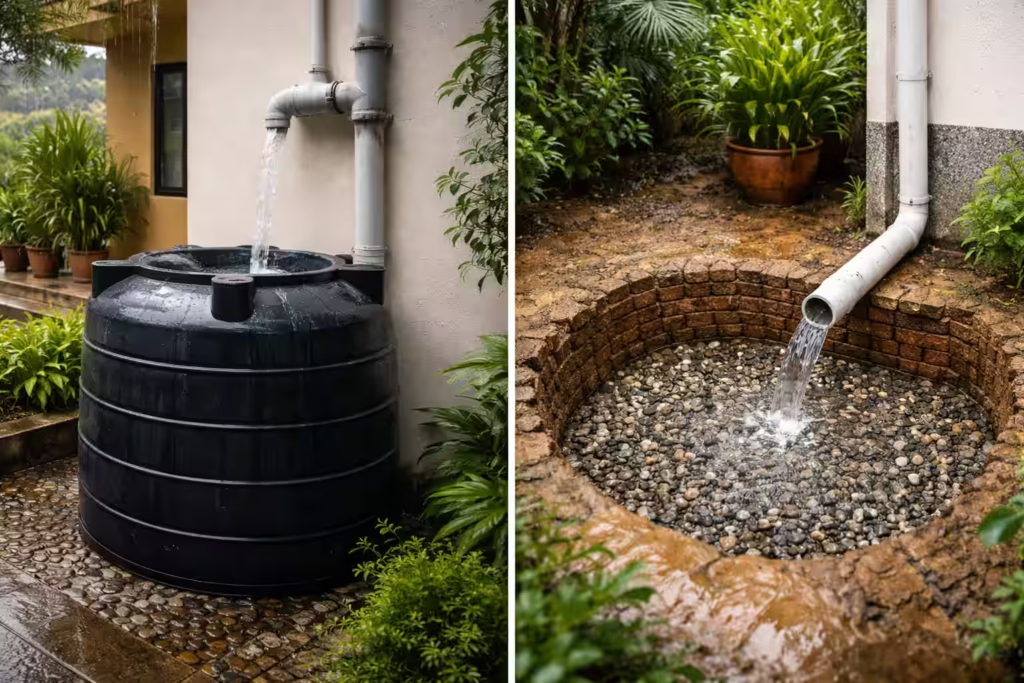
Recharge-based systems direct filtered rainwater into the ground through a recharge pit or recharge well. You do not get to use the water directly. Instead, you contribute to the local water table, which benefits your borewell and your neighbours’. This system costs significantly less to install and works better in areas with high rainfall and lower storage needs.
Tip
If you already have a functioning borewell, start with a recharge pit. A well-designed recharge pit in Bengaluru or Chennai can show measurable improvement in borewell water levels within two to three monsoon seasons. If you want to reduce your municipal water bill directly, build a storage tank instead.
Many homes install both: a storage tank for direct use and a recharge pit for overflow. This is the most effective setup for independent houses with a roof area above 150 sqm.
How to Calculate How Much Water Your Roof Can Harvest
You do not need a consultant for this. The basic formula is:
Harvestable water (litres) = Roof area (sqm) × Annual rainfall (mm) × Runoff coefficient
The runoff coefficient accounts for losses from evaporation, splashing, and first-flush discards. Not all rain that lands on your roof reaches your tank. Typical runoff coefficients by roof type:
| Roof Type | Runoff Coefficient |
|---|---|
| RCC or concrete terrace | 0.80 to 0.85 |
| Mangalorean clay tiles | 0.75 to 0.80 |
| Metal or GI sheet | 0.85 to 0.90 |
| Asphalt or bitumen sheet | 0.70 to 0.75 |
A worked example for five Indian cities, using a 100 sqm RCC terrace with a runoff coefficient of 0.80:
| City | Annual Rainfall (mm) | Harvestable Water (litres) |
|---|---|---|
| Bengaluru | 970 mm | 77,600 litres |
| Chennai | 1,400 mm | 1,12,000 litres |
| Delhi | 790 mm | 63,200 litres |
| Mumbai | 2,200 mm | 1,76,000 litres |
| Jaipur | 530 mm | 42,400 litres |
A family of four in an Indian home uses approximately 600 to 800 litres of water per day. Roughly 70 percent goes to non-drinking uses, such as toilets, mopping, gardening, and car washing, none of which require treated water. A 100 sqm roof in Bengaluru can cover most of that non-drinking demand for four to five months of the year.
Important
Do not include roof areas covered by AC outdoor units, water tanks, or solar panels in your calculation. These surfaces do not contribute clean runoff and can introduce contaminants. Measure only the clear, open roof area.
The Core Components of a Rooftop Rainwater Harvesting System
A standard rooftop rainwater harvesting system for Indian homes has five components:
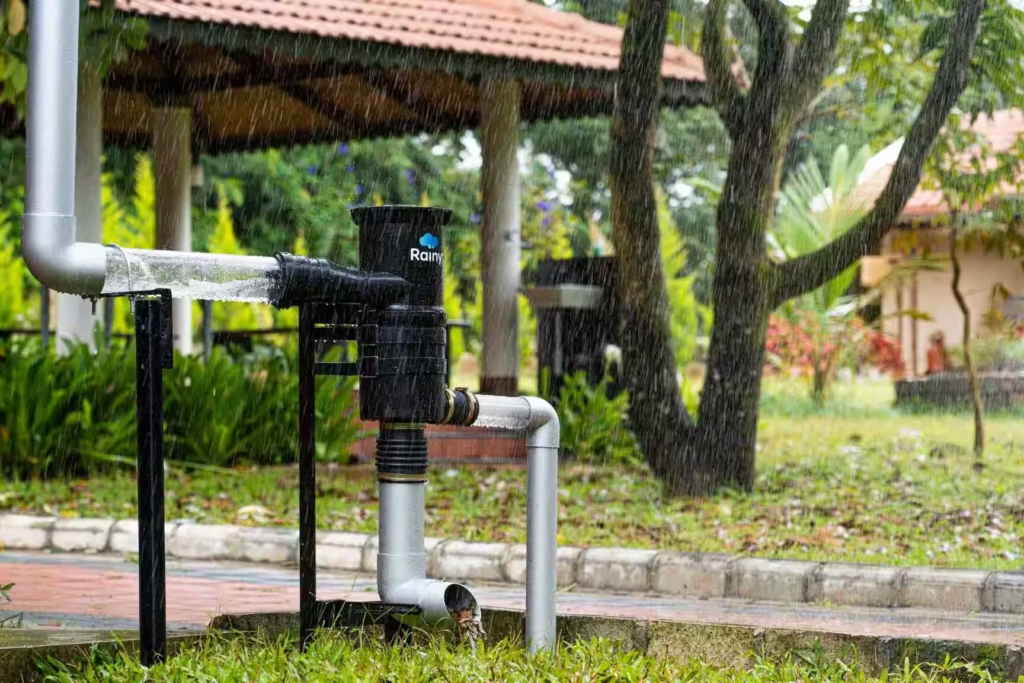
- Catchment area: The roof itself. RCC terraces work best. Ensure the surface is clean and free of materials like bird mesh netting that may leach chemicals into the water.
- Gutters and downpipes: Channels that carry rainwater from the roof edge to the collection point. PVC gutters cost Rs 80 to Rs 150 per linear metre. Stainless steel gutters cost more but last longer in coastal cities.
- First-flush diverter: A device that discards the first 15 to 20 litres of rainfall from each rain event, which carry accumulated dust and pollutants from the roof surface. This single component has the biggest impact on water quality and costs Rs 500 to Rs 2,000.
- Filter unit: Filters particles and suspended matter before water enters the storage tank or recharge pit. A sand-and-gravel filter works for recharge systems. For storage systems, a cartridge filter (Rs 2,000 to Rs 25,000) gives better output quality.
- Storage tank or recharge structure: The endpoint of the system. Underground sumps and HDPE tanks are the most common choices for Indian homes.
Quick Fact
The first-flush diverter is the most commonly skipped component in DIY setups across India. Skipping it means the most contaminated water from each storm goes directly into your tank or borewell. A Rs 500 diverter prevents months of contamination from a single oversight.
What a Rainwater Harvesting System Costs in India
Costs vary by system type, roof area, and component quality. The following breakdown reflects 2025 prices from vendors across Indian cities:
| Property Type | System Type | Approximate Cost (Rs) | What Is Included |
|---|---|---|---|
| Small house (100-150 sqm roof) | Basic storage (1,000-2,000 L tank) | Rs 20,000 to Rs 40,000 | Tank, basic filter, pipes, first-flush diverter, labour |
| Medium house (200-300 sqm roof) | Storage + recharge pit | Rs 40,000 to Rs 70,000 | 5,000 L tank, filtration unit, recharge pit, piping |
| Large house or villa | Full system | Rs 70,000 to Rs 1,20,000 | 10,000 L+ storage, advanced filter, recharge well |
| Apartment complex (10-20 flats) | Common system | Rs 2 lakh to Rs 5 lakh | Multiple tanks, shared recharge pits, large-scale piping |
For a medium house, the component cost breakdown looks like this: storage tank (5,000 L HDPE) at Rs 12,000 to Rs 20,000; filter unit at Rs 3,000 to Rs 8,000; gutters and downpipes at Rs 4,000 to Rs 10,000; first-flush diverter at Rs 500 to Rs 2,000; recharge pit at Rs 5,000 to Rs 12,000; and labour at Rs 8,000 to Rs 15,000.
Tip
Karnataka offers a 20 percent rebate on property tax for five years to homes with a functioning rainwater harvesting system. Surat Municipal Corporation offers a 50 percent subsidy up to Rs 2,000 on recharge installations. Check your local municipal corporation website for current subsidy schemes before starting procurement.
Apartments vs Independent Houses: How the Approach Changes
In an independent house or villa, you control the rooftop and can build any system you choose. In an apartment, you do not control the roof, and that changes everything.
For apartment dwellers, the practical path is a society-level system installed on the common terrace, maintained as a shared resource, and funded through the maintenance corpus. Here is how to push for one:
- Raise it at the next AGM. Present the per-flat cost (typically Rs 5,000 to Rs 15,000 per flat for a 20-flat building), the reduction in borewell dependency, and the legal compliance angle if your state mandates RWH.
- Check your state’s mandate. In Tamil Nadu and Maharashtra, new buildings are legally required to have RWH. If your society was built after the mandate year, it may already be non-compliant, which significantly strengthens your case.
- Get two vendor quotes. Local plumbing contractors with RWH experience and national suppliers can provide site-specific estimates to present to the committee.
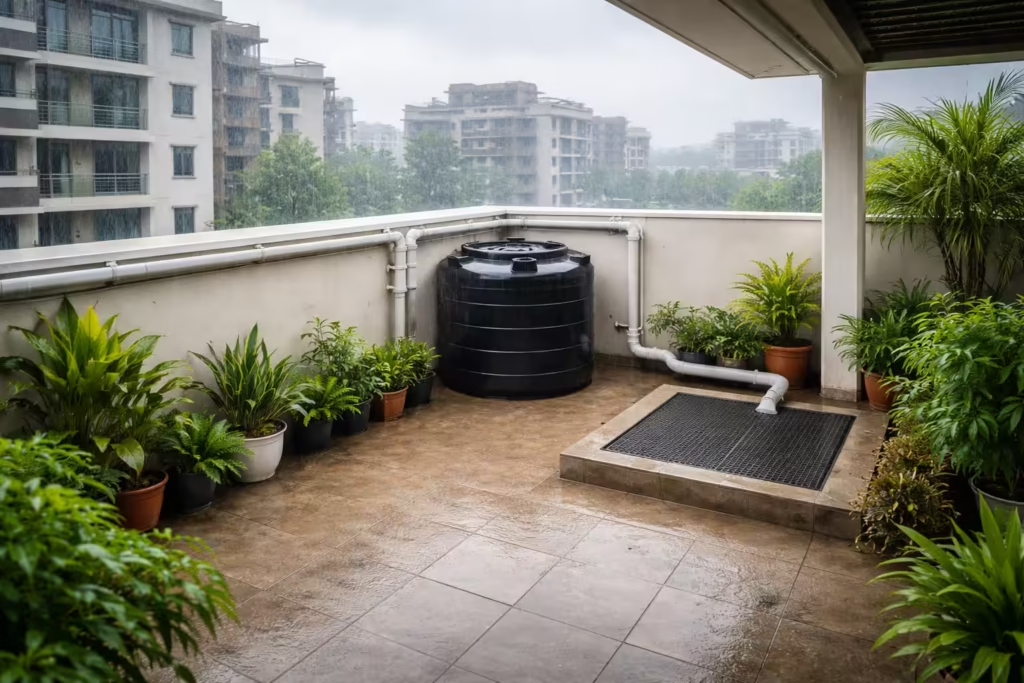
For flat dwellers who cannot get society approval, smaller-scale options include: balcony collection into a food-grade barrel for garden watering (50 to 100 litre capacity, Rs 1,500 to Rs 3,000) and advocating for the society to connect existing terrace drains to a recharge pit in the compound, which costs less and needs less committee buy-in than a full storage system.
Important
Do not run piping from your individual flat’s balcony to a storage unit in a way that modifies the building’s common drainage. This requires structural modification approval and an NOC from the housing society. Start with the society route first.
State-by-State: Where Rainwater Harvesting Is Mandatory
India does not have a single national mandate, but several states and cities have enacted their own rules. The following table reflects current legislation based on CSE India’s legislation tracker and state government sources:
| State or City | Mandate | Who It Applies to |
|---|---|---|
| Tamil Nadu | Mandatory since 2001, strengthened 2003 | All buildings. Water and sewer connections denied without RWH. |
| Maharashtra | Mandatory | Buildings on plots larger than 1,000 sqm |
| Rajasthan | Mandatory | Urban properties on plots larger than 500 sqm |
| Kerala | Mandatory since 2004 | All new buildings under Kerala Municipality Building Rules |
| Karnataka | Mandatory in major cities (population above 20 lakh) | All new buildings; 20% property tax rebate for 5 years |
| Himachal Pradesh | Mandatory | All urban buildings; no building plan approved without RWH |
| Delhi | Mandatory | Buildings on plots above 100 sqm |
| Surat | Mandatory | Plots above 4,000 sqm; 50% subsidy up to Rs 2,000 |
If your home falls under any of these mandates and does not have a functioning system, contact your local municipal corporation. Non-compliance in Tamil Nadu can result in disconnection of the municipal water supply.
How to Set Up Your System: A Step-by-Step Guide
This walkthrough covers a basic storage-and-recharge system for an independent house with a 100 to 200 sqm RCC terrace.
- Measure your catchment area: Walk your terrace and measure the clear, open area in sqm. Subtract areas covered by solar panels, water tanks, or AC units. Use the formula from Section 3 to estimate your annual harvest potential.
- Decide on storage volume: Plan for storage equal to 10 to 15 days of non-drinking water demand. For a family of four, that is 10 x 300 litres = 3,000 litres minimum. A 5,000-litre tank gives comfortable headroom.
- Install gutters and downpipes: If your terrace does not have gutters, install them along the lower edges. All downpipes should connect to a single collection point where you will fit the filter and diverter.
- Install the first-flush diverter: Fit this on the downpipe before water reaches the filter. The diverter fills with first-flush water and drains it slowly through a small hole at the base. Once full, clean water flows on to the filter.
- Install the filter: A three-layer filter (coarse gravel, fine gravel, sand) in a PVC drum costs under Rs 3,000 and works well for most setups. For higher quality output, use a commercial cartridge filter.
- Connect to the storage tank and recharge pit: Run filtered water to your storage tank. Add an overflow pipe from the tank to the recharge pit so excess water from heavy rain enters the ground rather than the drain.
- Clean before the first monsoon: Clean the terrace, flush the gutters, replace the filter media, and check all pipe joints for cracks before the season begins.
Tip
In cities with uneven monsoons like Bengaluru or Pune, fit a float valve in your storage tank. It automatically stops inflow once the tank is full and diverts everything to the recharge pit, maximising both usable storage and groundwater recharge from the same rain event.
Monsoon Maintenance Calendar
| When | Task |
|---|---|
| 2 weeks before monsoon | Clean terrace. Flush gutters. Replace filter media. Check all pipe joints for cracks. |
| First rain event | Let the first-flush diverter complete its cycle. Do not direct this water into the tank. |
| During monsoon (monthly) | Check and clean the filter. Remove leaves and debris from gutters. Confirm the tank lid is sealed. |
| End of monsoon | Drain and scrub the storage tank. Clean the recharge pit inlet. Flush all downpipes. |
| Off-season | Cover the tank opening with a tight mesh lid to prevent mosquito breeding. Inspect for cracks in the tank walls. |
The Bottom Line
Rooftop rainwater harvesting is one of the most cost-effective water upgrades an Indian homeowner can make. The infrastructure pays for itself within two to three monsoon seasons in cities with high water tariffs or borewell-dependent homes. You do not need a large roof or a large budget to start. A first-flush diverter, a basic filter, and a connection to your existing sump is enough to begin capturing water this season. Once you see the tank fill on the first monsoon day, letting that water run into a drain becomes impossible to justify.
FAQs
Can I drink harvested rainwater directly?
No. Rainwater collected from a rooftop contains dust, bird droppings, and traces of atmospheric pollutants. You can use it for toilet flushing, floor cleaning, gardening, and car washing without treatment. For drinking, you need a UV purifier or RO system in addition to standard filtration.
How long does a rainwater harvesting system last?
A well-maintained HDPE storage tank lasts 15 to 20 years. PVC gutters and pipes last 10 to 15 years. The filter media (sand and gravel) needs replacement every one to two monsoon seasons. Overall maintenance costs are low once the system is installed.
Is rainwater harvesting worth it in lower-rainfall cities like Delhi or Jaipur?
Yes, but focus on recharge rather than storage. Lower-rainfall cities typically have more severe groundwater depletion problems. A recharge pit improves borewell health meaningfully. A 100 sqm roof in Delhi still captures over 63,000 litres per year.
My apartment society refuses to install a system. What can I do?
Check whether your state mandates RWH for your building type. In Tamil Nadu and Maharashtra, non-compliance carries legal consequences. If the mandate applies to your building, your society has no legal standing to refuse. File a written complaint with the local municipal corporation if the management committee continues to block it.
Do I need a permit to install a rainwater harvesting system?
For most independent houses, no permit is required for a basic system with gutters, a filter, and an above-ground tank. An underground sump or a deep recharge well (below 3 metres) may require a no-objection certificate from your local municipal authority. Confirm with your municipal corporation before excavating.