
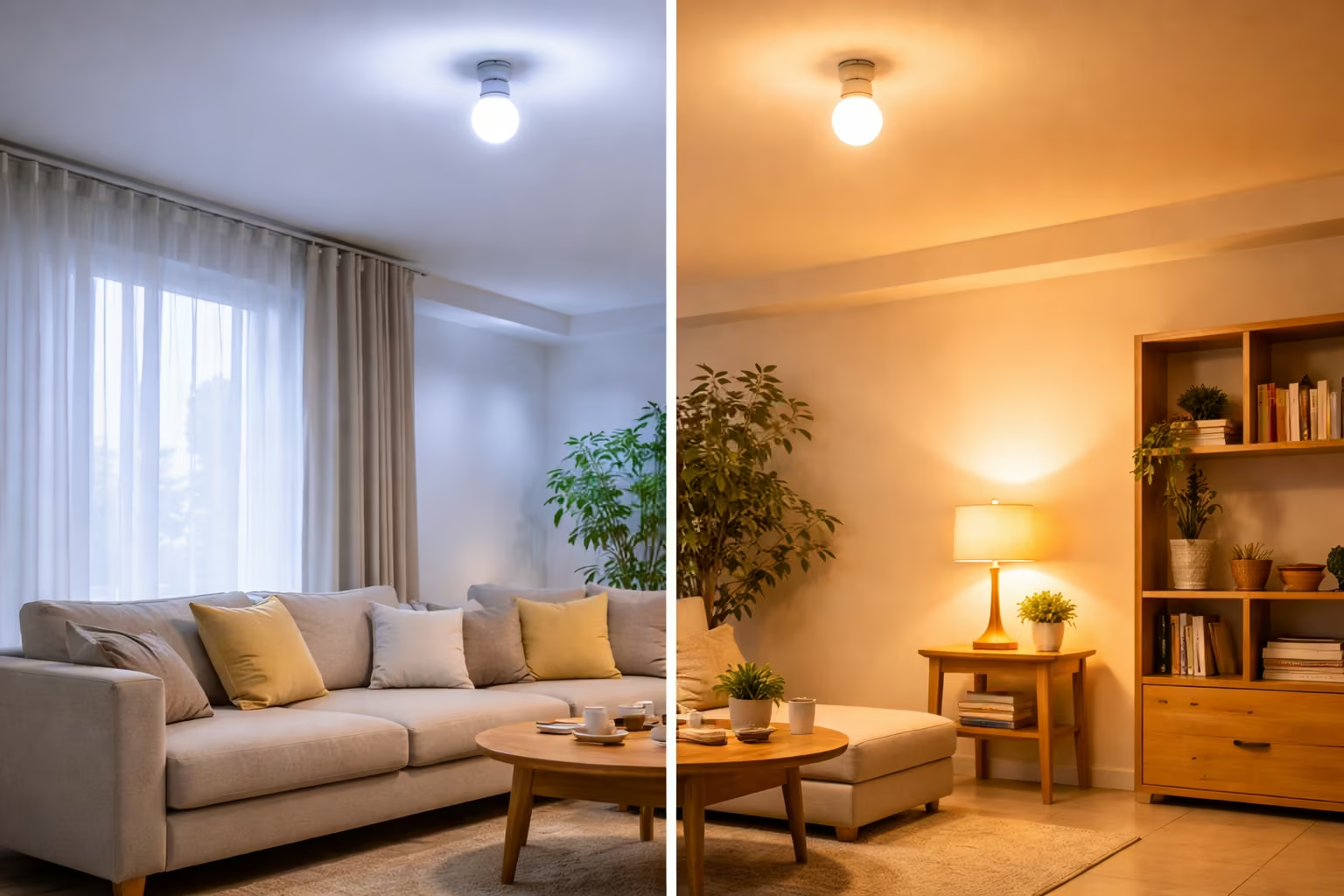
- Switching a 2BHK flat’s 10 light points from incandescent to LED saves Rs 840 to Rs 1,650 per month on electricity, with a full payback period of 4 to 8 weeks at current LED prices of Rs 70 to Rs 120 per bulb. No other eco-upgrade in this home delivers money back this fast.
- The Government of India’s UJALA scheme still sells BIS-certified LED bulbs at Rs 70 per bulb through DISCOM and state electricity board outlets, compared to Rs 150 to Rs 250 at retail. Most households are unaware this option exists.
- Most Indian buyers default to 6500K cool white for every room. This is the wrong choice for bedrooms and living rooms where warm 2700K light is better for relaxation and sleep. The room-by-room colour temperature guide below fixes this.
- A new mandatory BIS standard IS 16102 (Part 1): 2026 takes effect from August 2026. Any LED bulb without a BIS mark bought after that date may not comply with safety and performance standards. Check for the ISI mark on the box before buying.
Choosing the right LED bulb for home use in India is the fastest-payback eco-upgrade available: the bulbs cost Rs 70 to Rs 120 each, they last 15,000 to 25,000 hours, and the electricity savings pay back the purchase price within 4 to 8 weeks for most households. The difficulty is not finding an LED bulb. It is buying the right one when the boxes are covered in wattage, lumen, and Kelvin numbers that most buyers ignore and then wonder why one room feels like a hospital corridor and another like a candle-lit cave.
This guide runs the actual savings calculation for a standard Indian home, explains what every number on the box means in plain terms, covers the UJALA scheme subsidy that most buyers miss, and gives you five verified products at different price points with their actual specs.
In This Article
The Actual Savings: a Real Calculation for an Indian 2BHK
A standard 2BHK flat typically has 10 to 12 light points: ceiling lights in two bedrooms, a living room, a kitchen, a passage, and two bathrooms. If these are still running on 60W incandescent bulbs used for an average of 6 hours per day, here is the monthly electricity cost versus an LED replacement.
| Bulb Type | Wattage (10 bulbs) | kWh per Day | Monthly Units | Monthly Cost (Rs 7/unit) | Monthly Cost (Rs 9/unit) |
|---|---|---|---|---|---|
| Incandescent 60W | 600W total | 3.6 kWh | 108 units | Rs 756 | Rs 972 |
| CFL 14W | 140W total | 0.84 kWh | 25.2 units | Rs 176 | Rs 227 |
| LED 9W | 90W total | 0.54 kWh | 16.2 units | Rs 113 | Rs 146 |
Switching from incandescent to LED saves Rs 643 to Rs 826 per month on lighting alone. Switching from CFL to LED saves Rs 63 to Rs 81 per month, modest in cash terms but meaningful over 15,000 hours of LED lifespan. Ten LED bulbs at Rs 100 each cost Rs 1,000. At an incandescent-to-LED saving of Rs 643 per month, payback is under 2 months. At a CFL-to-LED saving of Rs 63 per month, payback is around 16 months, still well within the LED lifespan.
Quick Fact
India’s UJALA scheme has generated Rs 19,153 crore in annual electricity savings nationally, cutting peak power demand by 9,586 MW and reducing CO2 emissions by 3.87 crore tonnes annually. These numbers come from 36.87 crore LED bulbs distributed across 10 years. The scale shows what happens when an entire country replaces one bulb type with another.
What the Numbers on the Box Mean
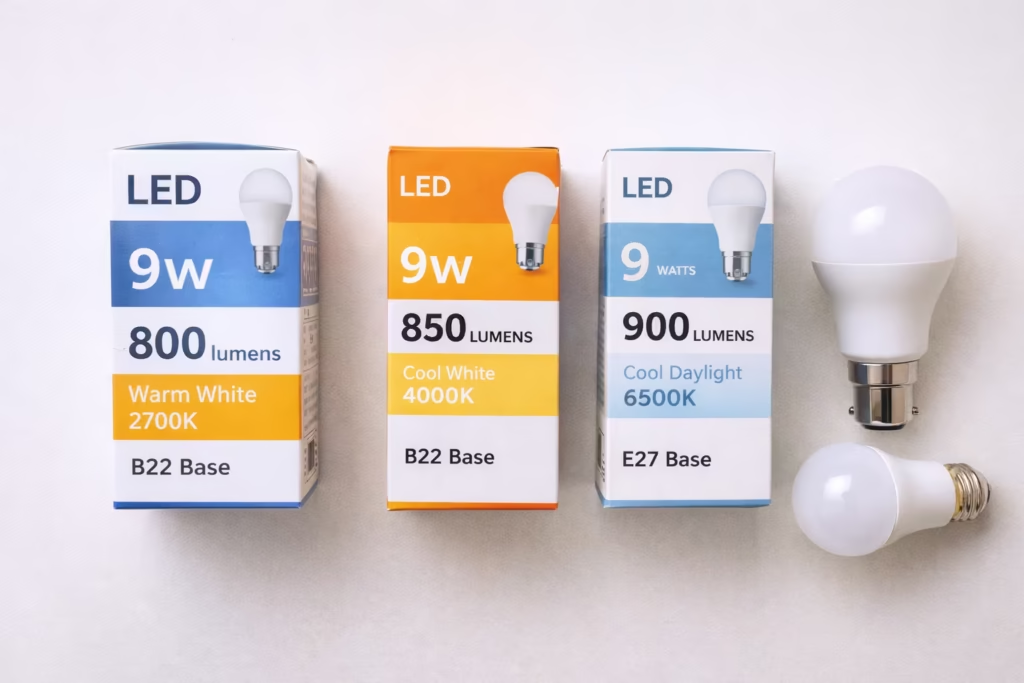
LED bulb boxes carry four key numbers. Understanding them takes 2 minutes and prevents most bad buying decisions.
| Number on Box | What It Means | How to Use It |
|---|---|---|
| Watts (W) | Electricity consumed per hour | Lower is better. A 9W LED gives the same brightness as a 60W incandescent. Never buy LEDs by wattage equivalence claims alone. |
| Lumens (lm) | Actual light output, the only accurate measure of brightness | A bedroom needs 200 to 400 lm per sqm. A kitchen or study needs 400 to 600 lm per sqm. A 9W LED is typically 800 to 900 lm. A 12W LED is 1,050 to 1,200 lm. |
| Colour Temperature (K) | How warm or cool the light looks. Lower K = warmer yellow light. Higher K = cooler blue-white light. | 2700K for bedrooms and living rooms. 4000K for kitchens and studies. 6500K only for garages, workshops, or task lighting. See the room guide below. |
| Base Type | The fitting that connects the bulb to the socket | B22 is the bayonet twist-and-click base. E27 is the screw base. Check your existing socket before buying. Most Indian homes use B22. |
Tip
To check your base type: unscrew your existing bulb and look at the metal fitting at the bottom. Two pins that click into place = B22. A single spiral thread = E27. All five products in this guide are available in both bases. B22 is stocked by every electrical shop in India; E27 may need an online order in smaller cities.
The UJALA Scheme: Buy LEDs at Rs 70 Through Your DISCOM
The Unnat Jyoti by Affordable LEDs for All (UJALA) scheme, run by Energy Efficiency Services Limited (EESL) under the Ministry of Power, still sells BIS-certified LED bulbs at Rs 70 per bulb through state electricity board and DISCOM outlets across India. This compares to Rs 150 to Rs 250 for the same spec bulb at a retail store. The scheme was launched in 2015 when market LED prices were Rs 450 to Rs 500, and has distributed 36.87 crore bulbs to date.
To access the scheme, visit your state electricity board’s customer service centre or DISCOM office with your electricity consumer number. Availability varies by state and stock. States where UJALA bulbs are actively distributed include Maharashtra, Rajasthan, Uttar Pradesh, Karnataka, Tamil Nadu, and Andhra Pradesh. You can also check the UJALA scheme portal at ujala.gov.in for your state’s current availability.
Important
UJALA bulbs are sold at Rs 70 per unit with a cap of typically 4 to 10 bulbs per household per year depending on your state’s distribution rules. They are not available at general retail shops. If the DISCOM counter in your city is out of stock, the five retail products below are the next best option at Rs 80 to Rs 130 each from Amazon, Flipkart, or local electrical stores.
Top 5 LED Bulbs for Indian Homes
1. Philips Stellar Bright 9W / 12W B22
Philips is the most trusted LED brand in India for consistent lumen output and lifespan. The Stellar Bright delivers 850 to 900 lm at 9W and 1,080 lm at 12W. BIS IS 16102-certified, available in 2700K warm white and 6500K cool daylight, stocked by virtually every electrical dealer in India. The 12W version is the right choice for large living rooms and halls. Rated lifespan is 15,000 hours. Pack-of-4 pricing on Amazon brings the per-bulb cost down to around Rs 180 to Rs 220.
- Wattage / Lumens: 9W / 850 lm or 12W / 1,080 lm
- Base: B22D (also available in E27)
- Colour options: 2700K warm white, 6500K cool daylight
- Price: Rs 70 to Rs 80 (UJALA outlets) or Rs 170 to Rs 220 (retail, pack of 4)
- Best for: All rooms, best first LED buy, widest availability
2. Crompton EcoGlo Dyna Ray 9W B22
Crompton has become the dominant volume LED brand in India since 2020. The EcoGlo Dyna Ray delivers 860 to 900 lm at 9W with a wide operating voltage range of 150V to 270V, making it reliable in areas with voltage fluctuation. BIS-certified, 2-year warranty, and priced at Rs 86 to Rs 100 per bulb. Available primarily in 6500K cool daylight in most retail packs.
- Wattage / Lumens: 9W / 860 to 900 lm
- Base: B22 (also available in E27)
- Colour options: 6500K cool daylight (primary stock)
- Price: Rs 86 to Rs 100 per bulb
- Best for: Budget upgrade, voltage fluctuation areas
3. Wipro Garnet 9W B22
Built specifically for Indian voltage conditions with above-average surge protection. One of the few budget LEDs available in 3000K warm white in B22 format, useful for bedrooms that want something warmer than 4000K but less yellow than 2700K. 9W, 900 lm, 2-year warranty. Preferred choice in Tier 2 and Tier 3 cities where supply voltage drops regularly.
- Wattage / Lumens: 9W / 900 lm
- Base: B22 (also available in E27)
- Colour options: 3000K warm white, 6500K cool daylight
- Price: Rs 90 to Rs 130 per bulb
- Best for: Voltage fluctuation areas, Tier 2/3 cities, bedroom warm light
4. Halonix Prime 12W B22
At 12W and 1,200 lm, the highest lumen output in this list. The best value-per-lumen product here at Rs 100 to Rs 160 per bulb. BIS-certified with a rated lifespan of 20,000 hours, the longest in this roundup. Best suited for kitchen lighting and living room main lights where brightness matters more than ambience. Available in 4000K neutral white and 6500K cool daylight.
- Wattage / Lumens: 12W / 1,200 lm
- Base: B22 (also available in E27)
- Colour options: 4000K neutral white, 6500K cool daylight
- Price: Rs 100 to Rs 160 per bulb
- Best for: Large rooms, kitchens, halls, replacing fluorescent tubes
5. Syska SSK-SRL 9W B22
India’s largest domestically headquartered LED brand with manufacturing in India. Available in 2700K, 4000K, and 6500K in the same B22 format, which lets you standardise on one brand while getting the right colour temperature for each room. 9W, 810 to 900 lm, BIS-certified, 2-year warranty. Rs 80 to Rs 120 per bulb. Available at most electrical shops and all major e-commerce platforms.
- Wattage / Lumens: 9W / 810 to 900 lm
- Base: B22 (also available in E27)
- Colour options: 2700K, 4000K, and 6500K all available
- Price: Rs 80 to Rs 120 per bulb
- Best for: Made-in-India preference, buying one brand for all rooms
| Product | Wattage | Lumens | Colour Temp Options | Price | Best For |
|---|---|---|---|---|---|
| Philips Stellar Bright 9W / 12W | 9W or 12W | 850 to 1,080 lm | 2700K, 6500K | Rs 170 to Rs 220 (pack of 4) | All rooms, widest availability |
| Crompton EcoGlo Dyna Ray 9W | 9W | 860 to 900 lm | 6500K primarily | Rs 86 to Rs 100 | Budget upgrade, voltage fluctuation areas |
| Wipro Garnet 9W | 9W | 900 lm | 3000K, 6500K | Rs 90 to Rs 130 | Tier 2/3 cities, bedroom warm light |
| Halonix Prime 12W | 12W | 1,200 lm | 4000K, 6500K | Rs 100 to Rs 160 | Large rooms, kitchens, halls |
| Syska SSK-SRL 9W | 9W | 810 to 900 lm | 2700K, 4000K, 6500K | Rs 80 to Rs 120 | Made-in-India, all rooms one brand |
Colour Temperature by Room
Most Indian buyers choose 6500K cool white for every room because it looks brighter in the shop. This is a mistake for any room where you relax, sleep, or eat. The 6500K blue-white light suppresses melatonin production, making it harder to wind down in the evening. It also makes food look less appetising and living rooms feel clinical rather than comfortable.
| Room | Recommended Temperature | Why | What to Avoid |
|---|---|---|---|
| Bedroom | 2700K warm white | Promotes relaxation, does not suppress melatonin, feels like incandescent light | Avoid 6500K: causes sleep disruption |
| Living room | 2700K to 3000K | Comfortable for conversation, television, and entertaining | Avoid 6500K: too harsh for extended sitting |
| Kitchen | 4000K neutral white | Bright enough for safe food preparation and accurate colour rendering | Avoid 2700K: yellow light makes it hard to judge food colour |
| Study or home office | 4000K to 5000K | Maintains alertness and focus without the extreme blue shift of 6500K | Avoid 2700K for desk light: too dim for sustained concentration |
| Bathroom | 3000K to 4000K | Accurate skin tone rendering for grooming, warm enough for morning routines | Avoid 6500K at night: too stimulating |
| Dining area | 2700K warm white | Makes food look appetising, creates an intimate atmosphere for meals | Avoid 6500K: makes food look unappetising |
| Garage, storage, utility | 5000K to 6500K | Maximum brightness for task work and cleaning | No issue with 6500K here |
Tip
If you can only buy one colour temperature for your whole home, 3000K soft white is the best compromise. It is warm enough for bedrooms and living rooms, bright enough for kitchens and bathrooms, and will not create the melatonin-suppressing effect of 6500K. Syska and Wipro both stock 3000K in B22 format at the same price as their other colour options.
What to Check on the Box: BIS Mark and BEE Star Rating
Two marks on an LED bulb box tell you whether the product is safe and energy-efficient.
- BIS ISI mark (IS 16102): A mandatory certification from the Bureau of Indian Standards. The updated IS 16102 (Part 1): 2026 standard takes effect from August 2026, requiring photo-biological safety testing, surge and fault condition testing, and verified lumen output. An LED bulb without a BIS mark has not been independently tested to Indian safety standards.
- BEE star rating: The Bureau of Energy Efficiency star label (1 to 5 stars) rates energy efficiency. A 5-star LED bulb delivers more lumens per watt than a 3-star bulb. All five products in this guide carry 4 to 5 star BEE ratings. No-brand imports typically carry no BEE rating.
- Lumens claim on box vs actual output: BIS certification requires verified lumen output. A box claiming 900 lm must deliver at least 90% of that in standardised testing. Uncertified products have no such requirement and often deliver 60 to 70% of the claimed output.
FAQs
How Many Watts Is Enough for a Bedroom?
For a standard Indian bedroom of 100 to 120 sq ft, a single 9W LED (800 to 900 lm) as the main ceiling light is adequate. If the room is larger (140 to 180 sq ft) or has a low ceiling, a 12W LED is better. Add a 7W bedside lamp in 2700K for reading without disturbing a sleeping partner. Two lower-wattage bulbs in a room give more even light distribution than one bright central light.
Can I Mix LED and CFL Bulbs in the Same House?
Yes, technically. Mixing bulb types in different rooms has no electrical problem. As CFL bulbs fail, replacing them with LEDs one at a time is the most practical approach. Do not mix CFL and LED in the same room fixture as colour temperatures rarely match and the brightness difference is visible. CFLs also contain small amounts of mercury that require careful disposal, unlike LEDs.
Do LEDs Work on Inverter Power in India?
Yes, and this is one of the main advantages of LED over other bulb types. A standard home inverter of 800VA handles 9W to 12W LED bulbs easily. Ten 9W LEDs draw only 90W total, extending your inverter backup time significantly compared to running CFLs (140W total) or tube lights. If you are on a solar home system or battery backup, replacing all lights with LEDs is the single highest-impact action to extend backup hours.
Why Does My LED Bulb Flicker?
LED flickering in Indian homes is almost always caused by one of three things: a loose connection at the socket, a faulty or incompatible dimmer switch (standard Indian dimmers are designed for incandescent bulbs and do not work with most LEDs), or low voltage at the mains causing the driver circuit to fluctuate. For dimmer switch flickering, replace the dimmer with an LED-compatible dimmer or remove it entirely. For low voltage flickering, models like Crompton EcoGlo and Wipro Garnet with wide operating voltage ranges (150V to 270V) are more stable than budget imports.
What Is the Actual Lifespan of an LED Bulb in India?
Manufacturer-rated lifespans of 15,000 to 25,000 hours assume controlled conditions. In Indian homes with voltage fluctuations, heat, and dust, expect 60 to 80% of the rated lifespan in practice, or approximately 9,000 to 20,000 hours. At 6 hours daily use, that is 4 to 9 years per bulb. BIS-certified bulbs from established brands perform significantly better than uncertified imports, which often fail within 6 to 12 months. Frequent voltage surges during monsoon season are the single biggest cause of premature LED failure in India.